
1. Introduction
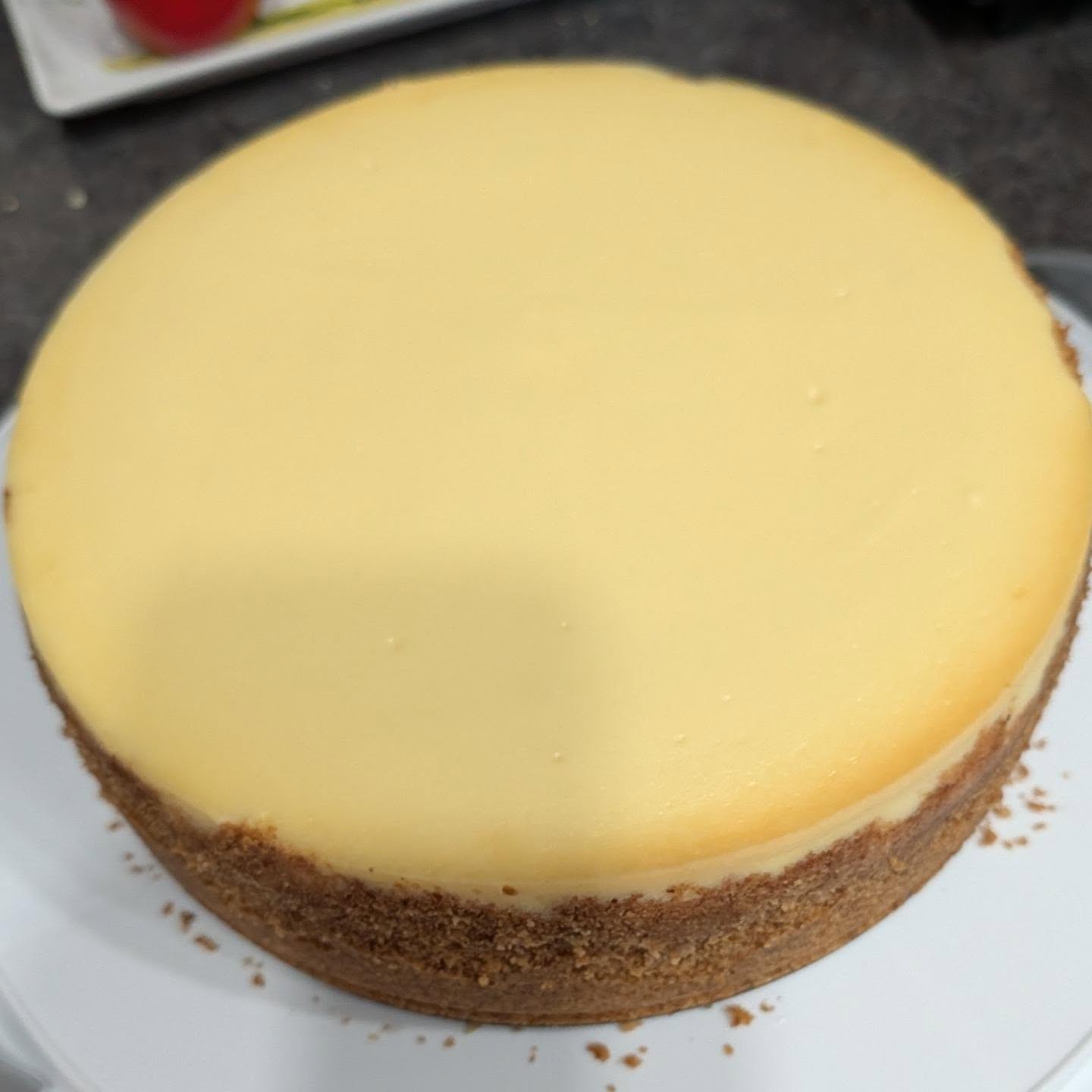
Classic Baked Cheesecake is an elegant, indulgent dessert featuring a thick, buttery biscuit crust and a smooth, rich cream cheese filling with a beautifully pale golden surface.
This bakery-style cheesecake is inspired by the famous New York-style dessert, celebrated for its dense yet creamy texture, delicate vanilla flavor, and luxurious consistency.
Unlike no-bake cheesecakes, which rely on refrigeration and sometimes gelatin to achieve their structure, baked cheesecake develops its characteristic texture through the gentle cooking of cream cheese, eggs, sugar, and sour cream.
The result is a rich, velvety dessert that holds its shape when sliced while remaining wonderfully creamy inside.
One of the most desirable features of a perfectly baked cheesecake is its smooth, nearly flat surface without large cracks.
Achieving this finish requires careful preparation, gentle mixing, controlled baking temperatures, and gradual cooling.
A water bath helps distribute heat evenly around the cheesecake, reducing the risk of overcooked edges and excessive cracking.
The thick biscuit crust provides a delicious contrast to the soft filling. Made from crushed graham crackers or digestive biscuits, melted butter, and sugar, it creates a firm, golden base with a delicate crunch.
This homemade cheesecake is ideal for birthdays, holidays, dinner parties, family gatherings, and special celebrations.
Although it requires several hours of cooling and refrigeration, the actual preparation is straightforward.
With quality ingredients, patience, and careful attention to temperature, you can create a beautiful homemade cheesecake with a creamy center, rich vanilla flavor, and buttery biscuit crust.
2. Origin and Cultural Significance
Cheesecake has a long history that extends far beyond modern American baking.
Early forms of cheese-based cakes were prepared in ancient Mediterranean cultures, including Greece, where mixtures of cheese, grains, and sweeteners were used in baked preparations.
Over the centuries, cheesecake recipes evolved throughout Europe, with different regions developing their own versions using local cheeses and baking techniques.
European cheesecakes may feature ingredients such as quark, ricotta, farmer’s cheese, or other soft cheeses.
The modern American cream cheese cheesecake developed after commercially produced cream cheese became widely available in the United States.
New York-style cheesecake became especially famous during the twentieth century, gaining recognition for its rich texture and generous use of cream cheese.
Compared with lighter cheesecake varieties, New York-style cheesecake is typically dense, smooth, and creamy.
Some recipes include sour cream or heavy cream to create a more delicate consistency and a subtle tang.
The graham cracker crust also became a familiar feature of American cheesecakes, providing a convenient alternative to traditional pastry bases.
Today, baked cheesecake is enjoyed worldwide and appears in countless variations, including strawberry cheesecake, chocolate cheesecake, lemon cheesecake, caramel cheesecake, and classic vanilla cheesecake.
Its popularity comes from the combination of simple ingredients, luxurious texture, and versatility.
3. Ingredients
For the Buttery Biscuit Crust
- 200 g (approximately 1½ cups, depending on crumb size) graham crackers or digestive biscuits, finely crushed
- 75 g (5 tablespoons plus a little extra) unsalted butter, melted
- 2 tablespoons granulated sugar
For the Creamy Cheesecake Filling
- 900 g (32 oz) full-fat brick-style cream cheese, softened completely to room temperature
- 200 g (1 cup) granulated sugar
- 230 g (1 cup) full-fat sour cream, at room temperature
- 1 tablespoon vanilla extract
- 4 large eggs, at room temperature
- 2 tablespoons cornstarch or all-purpose flour
For the Water Bath
- Boiling water, enough to reach approximately halfway up the sides of the cheesecake pan
- Heavy-duty aluminum foil, for wrapping the springform pan
Optional Garnishes
- Fresh strawberries
- Fresh raspberries
- Blueberries
- Strawberry sauce
- Raspberry coulis
- Caramel sauce
- Whipped cream
- A light dusting of powdered sugar
Ingredient Note: Full-fat brick-style cream cheese is recommended for the most reliable texture. Spreadable cream cheese sold in tubs may contain more moisture and produce a softer filling.
4. Optional Additions
Customize your classic baked cheesecake with:
- Lemon zest: Add finely grated lemon zest for a bright citrus aroma.
- Vanilla bean paste: Replace part of the vanilla extract with vanilla bean paste for visible vanilla specks.
- Strawberry topping: Spoon homemade strawberry compote over chilled cheesecake slices.
- Raspberry sauce: Add a tangy fruit sauce to balance the rich filling.
- Blueberry compote: Serve with gently cooked blueberries and a little sugar.
- Salted caramel: Drizzle lightly over individual slices.
- Chocolate ganache: Add a thin layer of chocolate ganache after chilling.
- Crushed cookies: Sprinkle over the finished cheesecake for additional texture.
- Whipped cream: Pipe small decorative swirls around the edge.
- Orange zest: Add a small amount for a subtle citrus variation.
For a traditional vanilla cheesecake, keep the filling simple and serve the cake without heavy toppings.
5. Tips for Success
- Use full-fat cream cheese for a rich, stable filling.
- Allow the cream cheese, eggs, and sour cream to reach room temperature before mixing.
- Crush the biscuits finely for a firm, even crust.
- Press the crust firmly into the springform pan.
- Prebake the crust to help it hold together.
- Beat the cream cheese until smooth before adding the eggs.
- Mix at low speed to avoid incorporating excessive air.
- Add the eggs one at a time.
- Scrape down the mixing bowl frequently.
- Avoid overbeating after the eggs are added.
- Use a water bath for gentle, even baking.
- Protect the springform pan carefully from water leaks.
- Avoid opening the oven repeatedly during baking.
- Remove the cheesecake from active heat while the center still has a slight jiggle.
- Allow the cheesecake to cool gradually.
- Refrigerate for at least 6 hours before slicing.
- Use a warm, clean knife for neat slices.
Important: A water bath and slow cooling greatly reduce the likelihood of cracks, but they cannot guarantee a perfectly crack-free surface every time.
6. Step-by-Step Instructions
Step 1: Gather the Ingredients
Measure the cream cheese, sugar, sour cream, vanilla extract, eggs, cornstarch, biscuits, and butter.
Allow the refrigerated filling ingredients to reach room temperature.
This helps them combine smoothly without excessive mixing.
Step 2: Preheat the Oven
Preheat your oven to 350°F (175°C).
Position an oven rack in the lower-middle section.
Step 3: Prepare the Springform Pan
Use a 9-inch (23 cm) springform pan.
Lightly grease the bottom and sides.
If desired, line the bottom with parchment paper for easier removal.
Step 4: Crush the Biscuits
Place 200 g graham crackers or digestive biscuits in a food processor.
Process until fine crumbs form.
Alternatively, place the biscuits in a sealed bag and crush them with a rolling pin.
Step 5: Add the Sugar
Transfer the biscuit crumbs to a mixing bowl.
Add 2 tablespoons granulated sugar.
Stir until evenly combined.
Step 6: Melt the Butter
Place 75 g unsalted butter in a small saucepan or microwave-safe bowl.
Heat gently until melted.
Allow it to cool slightly.
Step 7: Combine the Crust Ingredients
Pour the melted butter over the biscuit crumbs.
Mix thoroughly until the crumbs are evenly moistened.
The mixture should resemble damp sand.
Step 8: Transfer the Crust Mixture
Pour the prepared biscuit mixture into the springform pan.
Spread it evenly across the bottom.
Step 9: Press the Crust Firmly
Use the flat bottom of a measuring cup or glass to press the crumbs firmly into the pan.
Push some of the mixture slightly up the sides if desired.
A compact crust is less likely to crumble when sliced.
Step 10: Prebake the Crust
Place the pan in the preheated oven.
Bake for approximately 8–10 minutes.
The crust should become lightly golden and fragrant.
Step 11: Cool the Crust
Remove the pan from the oven.
Place it on a wire rack and allow the crust to cool completely.
Reduce the oven temperature to 325°F (160°C).
Step 12: Prepare the Cream Cheese
Place 900 g softened cream cheese into a large mixing bowl.
Use a stand mixer fitted with a paddle attachment or a handheld electric mixer.
Step 13: Beat Until Smooth
Beat the cream cheese on medium-low speed until smooth and creamy.
Stop occasionally to scrape down the sides and bottom of the bowl.
Step 14: Add the Sugar
Gradually add 200 g granulated sugar.
Continue mixing on medium-low speed until evenly incorporated.
Avoid whipping the mixture aggressively.
Step 15: Check for Lumps
Stop the mixer.
Scrape the bowl thoroughly with a spatula.
The mixture should appear smooth and uniform.
If small lumps remain, mix briefly until they disappear.
Step 16: Add the Sour Cream
Add 230 g room-temperature sour cream.
Mix on low speed until incorporated.
The sour cream adds a subtle tanginess and helps create a creamy texture.
Step 17: Add the Vanilla Extract
Pour in 1 tablespoon vanilla extract.
Mix gently until distributed throughout the filling.
Step 18: Add the Cornstarch
Sprinkle 2 tablespoons cornstarch or all-purpose flour over the mixture.
Mix on low speed until combined.
The starch helps stabilize the filling during baking.
Step 19: Prepare the Eggs
Crack 4 large eggs into a separate bowl.
Check for any shell fragments.
Step 20: Add the First Egg
Add one egg to the cream cheese mixture.
Mix on low speed just until incorporated.
Step 21: Add the Remaining Eggs
Add the remaining eggs one at a time.
Mix gently after each addition.
Avoid overmixing, as excessive air can cause the cheesecake to rise too much and crack during cooling.
Step 22: Finish the Filling
Stop the mixer once the eggs are fully incorporated.
Use a spatula to scrape the sides and bottom of the bowl.
Gently fold the mixture a few times to ensure an even consistency.
Step 23: Remove Excess Air Bubbles
Tap the mixing bowl gently against the countertop a few times.
This can help release some larger air bubbles.
Step 24: Prepare the Springform Pan for the Water Bath
Wrap the outside of the springform pan securely with two layers of heavy-duty aluminum foil.
Cover the bottom and extend the foil well up the sides.
For additional protection, place the springform pan inside a slightly larger solid cake pan before setting it in the water bath.
Step 25: Pour the Filling Over the Crust
Transfer the cheesecake filling into the cooled biscuit crust.
Pour slowly to minimize trapped air.
Step 26: Smooth the Surface
Use an offset spatula to gently smooth the top.
The surface should be even and level.
Step 27: Prepare the Roasting Pan
Place the wrapped cheesecake pan inside a large, deep roasting pan.
Ensure there is enough space around the cheesecake pan for water.
Step 28: Add the Hot Water
Carefully pour boiling water into the roasting pan until it reaches approximately halfway up the outside of the cheesecake pan.
Avoid splashing water into the filling.
Step 29: Transfer to the Oven
Carefully place the roasting pan in the oven.
Bake at 325°F (160°C).
Step 30: Bake the Cheesecake
Bake for approximately 60–70 minutes.
The cheesecake should gradually become set around the edges.
The center should remain slightly soft.
Step 31: Check for Doneness
Gently move the pan to observe the filling.
The outer portion should appear set, while the center should have a slight wobble.
Avoid waiting until the entire cheesecake becomes completely firm.
A cheesecake that is overbaked is more likely to crack.
Step 32: Turn Off the Oven
Once the cheesecake is ready, turn off the oven.
Leave the cheesecake inside.
Step 33: Open the Oven Door Slightly
Crack the oven door open a few inches.
Allow the cheesecake to rest inside the gradually cooling oven for approximately 1 hour.
This helps reduce sudden temperature changes.
Step 34: Remove the Cheesecake
Carefully remove the roasting pan from the oven.
Lift the cheesecake pan out of the water bath.
Remove the aluminum foil.
Step 35: Release the Edges
While the cheesecake is still slightly warm, gently run a thin knife around the inside edge of the springform pan.
This helps prevent the cheesecake from sticking to the sides as it contracts during cooling.
Step 36: Cool to Room Temperature
Place the cheesecake on a wire rack.
Allow it to cool until it reaches room temperature.
Do not leave it unrefrigerated for more than 2 hours.
Step 37: Cover the Cheesecake
Once cooled, cover the cheesecake loosely with plastic wrap or a suitable lid.
Avoid allowing the covering to touch the surface.
Step 38: Refrigerate
Place the cheesecake in the refrigerator for at least 6 hours.
For the best texture and cleanest slices, refrigerate overnight.
Step 39: Remove the Springform Ring
Once thoroughly chilled, carefully release the springform pan.
Lift away the outer ring.
Transfer the cheesecake to a serving plate if desired.
Step 40: Slice and Serve
Dip a sharp knife into hot water and wipe it dry.
Cut the cheesecake into even slices.
Clean the knife between cuts for smooth edges.
Serve chilled, plain or with your favorite fruit topping.
7. Description
Classic Baked Cheesecake is a rich, creamy dessert featuring a smooth vanilla cream cheese filling and a thick, buttery biscuit crust.
The filling has a dense yet velvety consistency, allowing each slice to hold its shape while remaining soft and creamy.
The flavor is gently sweet, with a delicate tanginess from the cream cheese and sour cream.
Vanilla extract adds warmth and depth without overpowering the natural dairy flavor.
The biscuit crust provides a firm, slightly crunchy contrast to the silky filling.
When baked and cooled properly, the cheesecake develops a smooth, pale surface with minimal browning.
The finished dessert has a clean, elegant appearance, making it suitable for both simple family meals and formal celebrations.
Each bite combines the buttery sweetness of the crust with the rich, creamy texture of the filling.
8. Nutritional Information
Approximate values per serving, assuming the cheesecake is divided into 12 slices:
| Nutrient | Estimated Amount |
|---|---|
| Calories | 540–610 kcal |
| Protein | 9–11 g |
| Carbohydrates | 38–45 g |
| Total Fat | 39–45 g |
| Saturated Fat | 23–27 g |
| Fiber | Less than 1 g |
| Sugar | 29–35 g |
| Sodium | 350–450 mg |
These values are estimates and depend on the cream cheese, biscuits, sour cream, and portion size used.
9. Recipe Details
| Category | Details |
|---|---|
| Recipe Name | Classic Baked Cheesecake |
| Style | New York-Style Inspired |
| Cuisine | American |
| Preparation Time | 25–35 Minutes |
| Crust Baking Time | 8–10 Minutes |
| Cheesecake Baking Time | 60–70 Minutes |
| Oven Cooling Time | 1 Hour |
| Additional Cooling | Approximately 1–2 Hours |
| Refrigeration Time | At Least 6 Hours |
| Total Time | Approximately 10–12 Hours |
| Pan Size | 9-Inch Springform Pan |
| Yield | 1 Cheesecake |
| Servings | 12 Slices |
| Difficulty | Intermediate |
| Main Ingredients | Cream Cheese, Eggs, Sugar, Sour Cream |
| Cooking Method | Baking in a Water Bath |
| Course | Dessert |
| Texture | Dense, Smooth, Creamy, Velvety |
| Flavor Profile | Rich, Buttery, Vanilla, Slightly Tangy |
| Best For | Birthdays, Holidays, Dinner Parties, Celebrations |
10. Conclusion
Classic Baked Cheesecake is a timeless dessert that combines a rich, smooth cream cheese filling with a buttery biscuit crust.
Its luxurious texture, delicate vanilla flavor, and elegant appearance make it a wonderful choice for special occasions.
Although cheesecake requires patience, particularly during baking and cooling, the preparation process is straightforward when each step is followed carefully.
The most important techniques include using room-temperature ingredients, mixing gently, baking in a water bath, and allowing the cheesecake to cool gradually.
Refrigerating the cheesecake overnight helps develop its firm yet creamy texture and makes slicing easier.
Whether served plain or topped with fresh berries, fruit sauce, or caramel, homemade baked cheesecake is a delicious dessert that can be enjoyed throughout the year.
11. Serving and Storage Recommendations
Serve with:
- Fresh strawberries
- Fresh raspberries
- Blueberries
- Strawberry compote
- Raspberry coulis
- Salted caramel sauce
- Chocolate ganache
- Whipped cream
- Fresh mint leaves
- Coffee or espresso
Serving: Serve cheesecake chilled or allow individual slices to stand at room temperature for approximately 10–15 minutes before serving.
Refrigeration: Store cheesecake in an airtight container in the refrigerator for approximately 3–4 days for best quality.
Room Temperature: Because cheesecake contains cream cheese, sour cream, and eggs, refrigerate it within 2 hours of removal from temperature-controlled storage.
Freezing: Wrap individual slices tightly in plastic wrap and place them in freezer-safe containers. Freeze for up to 2–3 months for best quality.
Thawing: Transfer frozen slices to the refrigerator and allow them to thaw gradually.
Make-Ahead: Prepare the cheesecake one day before serving. Overnight refrigeration helps the filling set completely.
Storage Tip: Keep fruit toppings separate until serving to prevent excess moisture from softening the cheesecake surface.
Presentation Tip: For smooth, professional-looking slices, use a sharp knife warmed in hot water and wiped dry between cuts.
12. Embracing Healthful Indulgence
Classic Baked Cheesecake is a rich dessert intended for occasional enjoyment.
Its main ingredients include cream cheese, eggs, sour cream, sugar, butter, and biscuits.
Cream cheese and sour cream contribute the luxurious texture and distinctive tangy flavor.
Eggs provide protein and help the filling set during baking.
The biscuit crust adds carbohydrates and buttery richness, creating a satisfying contrast to the creamy filling.
Because cheesecake contains significant amounts of saturated fat and added sugar, portion size is worth considering.
Serving smaller slices alongside fresh berries can add freshness, color, and additional nutrients.
Fresh strawberries, raspberries, and blueberries also provide fiber and naturally occurring vitamins.
For a slightly lighter variation, you can experiment with reducing the sugar modestly or using a thinner biscuit crust, although substantial changes to the filling may affect its texture and stability.
The classic full-fat version remains particularly well suited to occasions when a rich, creamy dessert is desired.
With its thick buttery biscuit crust, smooth vanilla filling, creamy texture, and elegant presentation, Classic Baked Cheesecake is a memorable homemade dessert to share with family and friends.