
Preparation Time: 10 minutes
Additional Preparation: 30 minutes
Cooking Time: 8–12 minutes
Resting Time: 5–10 minutes
Total Time: Approximately 55–65 minutes
Yield: 1–2 servings
Difficulty: Intermediate
Cuisine: American Steakhouse-Inspired Cuisine
1. Introduction
Pan-Seared Ribeye Steak with Garlic Butter is a classic steakhouse-inspired dish celebrated for its rich flavor, tender texture, and beautifully caramelized exterior.
This preparation features a thick-cut ribeye steak cooked in a hot cast-iron skillet to develop a deep golden-brown crust while preserving its natural juiciness. The steak is finished with melted butter, freshly minced garlic, and aromatic herbs, creating a flavorful coating that enhances the natural characteristics of the beef.
The final touch of flaky sea salt adds a delicate crunch and highlights the savory qualities of the meat.
This recipe demonstrates how a small selection of quality ingredients, combined with proper cooking techniques, can create an elegant and satisfying meal at home.
2. Origin of Pan-Seared Ribeye Steak
Ribeye steak originates from the rib section of beef, specifically the rib primal, located along the upper back of the animal.
This particular cut is highly valued because of its natural marbling, which consists of small amounts of fat distributed throughout the muscle. During cooking, this fat contributes to the steak’s characteristic richness, tenderness, and flavor.
The ribeye became particularly popular in American steakhouses, where thick-cut beef steaks were traditionally prepared using high-temperature grilling, broiling, and pan-searing techniques.
Pan-searing is a traditional cooking method that uses direct contact between the meat and a hot cooking surface to develop a flavorful brown crust. The technique is associated with the Maillard reaction, a chemical process responsible for many of the appealing flavors and aromas produced when foods are browned.
The addition of butter, garlic, and fresh herbs reflects a widely appreciated steakhouse preparation style that combines the natural flavor of beef with aromatic ingredients.
Although ribeye has no single identifiable culinary inventor or place of origin, it has become one of the most recognized premium steak cuts in contemporary restaurant cooking.
3. Cultural Significance
Ribeye steak has an important place in contemporary American dining culture and international steakhouse traditions.
Steakhouse Dining
Ribeye is frequently featured on steakhouse menus because of its marbling, distinctive flavor, and suitability for high-temperature cooking. It is commonly associated with premium dining experiences.
Celebrations and Special Occasions
Steak is often selected for birthdays, anniversaries, family celebrations, and special dinners. Its generous presentation and rich flavor make it a popular centerpiece for special meals.
American Grilling Culture
Beef steak is closely associated with American barbecue and outdoor cooking traditions. Ribeye is particularly appreciated for its ability to develop a flavorful exterior while maintaining a tender interior.
Culinary Craftsmanship
Preparing a quality ribeye requires attention to temperature, timing, seasoning, and resting. These techniques demonstrate the importance of precision in professional and home cooking.
Hospitality and Food Presentation
Serving a thick-cut steak with garlic butter and fresh herbs reflects the steakhouse tradition of presenting simple ingredients in an elegant and visually appealing way.
4. Ingredients and Quantities
A. Main Steak
| Ingredient | Quantity |
|---|---|
| Thick-cut ribeye steak | 1 steak (approximately 1.5–2 inches thick) |
| Coarse sea salt | To taste |
| Freshly ground black pepper | To taste |
| Avocado, canola, or other high-heat cooking oil | 1–2 tablespoons |
The ribeye should have visible marbling distributed throughout the meat. A well-marbled cut generally provides a richer flavor and a more tender eating experience.
B. Garlic Butter Topping
| Ingredient | Quantity |
|---|---|
| Unsalted butter | 3–4 tablespoons |
| Fresh garlic cloves | 3–4 cloves |
| Fresh thyme | 2 sprigs (optional) |
| Fresh rosemary | 1–2 sprigs (optional) |
| Flaky sea salt | A pinch, for finishing |
C. Equipment Required
- Cast-iron skillet or heavy-bottomed frying pan.
- Kitchen tongs.
- Sharp chef’s knife.
- Cutting board.
- Paper towels.
- Instant-read meat thermometer.
- Small spoon for butter-basting.
5. Optional Additions
The recipe can be customized with additional ingredients to introduce different flavors and textures.
| Optional Ingredient | Suggested Quantity | Purpose |
|---|---|---|
| Dijon mustard | 1 teaspoon | Adds mild acidity |
| Worcestershire sauce | 1 teaspoon | Enhances savory flavor |
| Lemon juice | 1 teaspoon | Provides freshness |
| Smoked paprika | ¼ teaspoon | Adds smoky notes |
| Crushed red pepper | A pinch | Introduces mild heat |
| Fresh parsley | 1 tablespoon | Adds freshness |
| Blue cheese | 2 tablespoons | Creates a rich, tangy topping |
| Shallots | 1 tablespoon, minced | Adds a mild aromatic flavor |
| Compound garlic butter | 1 tablespoon | Enhances the finishing flavor |
These additions are optional and should be selected according to the desired flavor profile.
6. Tips for Success
- Choose a well-marbled ribeye: Visible intramuscular fat contributes to the steak’s characteristic richness and flavor.
- Dry the surface thoroughly: Use paper towels to remove surface moisture before cooking. A dry surface helps develop a better brown crust.
- Season evenly: Apply salt and freshly ground black pepper across both sides and the outer edges.
- Use a heavy skillet: Cast iron retains heat effectively and provides consistent contact with the meat.
- Preheat the skillet: Allow the pan to become sufficiently hot before adding the steak.
- Avoid overcrowding: Cook one steak at a time if necessary to maintain the pan temperature.
- Control the butter temperature: Add butter after the initial searing stage and reduce the heat to prevent the garlic and milk solids from burning.
- Use fresh garlic: Freshly minced garlic provides a stronger and more aromatic flavor than dried garlic powder.
- Monitor internal temperature: Use an instant-read thermometer rather than relying exclusively on cooking time. Thickness and pan temperature influence the final result.
- Allow the steak to rest: Resting before slicing helps retain more of the meat’s juices.
- Slice against the grain: Cutting across the muscle fibers produces a more tender bite.
- Finish with flaky salt: A small amount of flaky sea salt enhances the flavor and adds a delicate textural contrast.
7. Instructions and Preparation Method
Step 1: Prepare and Season the Steak
- Remove the ribeye from the refrigerator approximately 30 minutes before cooking, while following safe food-handling practices.
- Place the steak on a clean cutting board.
- Pat the surface completely dry using paper towels.
- Season both sides generously with coarse sea salt.
- Add freshly ground black pepper.
- Make sure the outer fat cap is also seasoned.
- Set the steak aside while preparing the skillet.
Step 2: Preheat the Skillet
- Place a cast-iron skillet over high heat.
- Allow the skillet to heat thoroughly.
- Add one to two tablespoons of avocado oil or another suitable high-heat cooking oil.
- Swirl the pan gently to distribute the oil.
- Once the oil is hot, carefully place the ribeye in the skillet.
Step 3: Sear the Steak
- Place the steak in the hot skillet.
- Allow the first side to sear undisturbed for approximately 2½–3 minutes.
- Turn the steak using kitchen tongs.
- Sear the opposite side for another 2½–3 minutes.
- Use the tongs to hold the steak against the skillet briefly to brown the outer fat cap.
- Check the crust to ensure it has developed a deep golden-brown color.
The objective is to create an evenly browned exterior while controlling the internal cooking temperature.
Step 4: Prepare the Garlic Butter
- Reduce the heat to medium.
- Add three to four tablespoons of unsalted butter to the skillet.
- Allow the butter to melt.
- Add three to four cloves of freshly minced garlic.
- Add the thyme and rosemary if desired.
- Stir gently to distribute the ingredients through the melted butter.
- Allow the garlic to release its aroma without burning.
Step 5: Butter-Baste the Ribeye
- Tilt the skillet slightly to collect the melted butter on one side.
- Use a large spoon to collect the garlic-infused butter.
- Repeatedly spoon the warm butter over the upper surface of the steak.
- Continue basting for approximately one to two minutes, adjusting the cooking time according to the steak’s thickness and internal temperature.
- Use an instant-read thermometer to monitor the center of the meat.
For a restaurant-style medium-rare result, the original recipe targets approximately 130–135°F (54–57°C). This is below the USDA’s recommended minimum of 145°F (63°C) followed by a three-minute rest for whole cuts of beef. Follow the applicable food-safety guidance when choosing the final doneness, particularly when serving people at higher risk from foodborne illness.
Step 6: Rest the Steak
- Remove the steak from the skillet once it reaches the selected cooking temperature.
- Transfer it to a clean cutting board.
- Spoon some of the remaining garlic butter over the surface.
- Allow it to rest for approximately 5–10 minutes.
- Avoid cutting immediately after removing it from the pan.
Step 7: Slice and Finish
- Identify the direction of the muscle fibers.
- Use a sharp knife to slice the steak against the grain.
- Arrange the slices on a warm serving plate or wooden board.
- Spoon additional garlic butter over the steak if desired.
- Finish with a small pinch of flaky sea salt.
- Serve immediately while warm.
8. Description
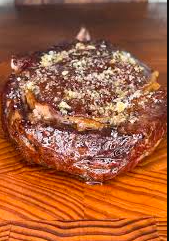
Pan-Seared Ribeye Steak with Garlic Butter is a premium beef preparation characterized by its deeply browned exterior, naturally marbled interior, and aromatic butter finish.
The ribeye is first seasoned with coarse salt and black pepper before being seared in a hot cast-iron skillet. This process develops a flavorful crust while creating the foundation for the dish’s characteristic steakhouse appearance.
During the final cooking stage, melted butter is combined with fresh garlic, thyme, and rosemary. The resulting mixture is repeatedly spooned over the steak, enriching its surface with aromatic flavors.
The finished dish features a dark golden-brown crust, a tender interior, and a glossy coating of garlic-infused butter.
As illustrated in the photograph, the steak is presented as a thick, beautifully seared cut, finished with finely minced garlic and visible flakes of seasoning.
The combination of savory beef, aromatic garlic, melted butter, and flaky salt creates a distinctive flavor profile.
9. Nutritional Information
The nutritional values below are approximate and depend on the steak’s size, marbling, and the amount of butter and oil consumed.
Estimated nutritional information per serving, assuming one large ribeye divided into two portions:
| Nutritional Component | Approximate Quantity |
|---|---|
| Calories | 600–800 kcal |
| Protein | 40–50 g |
| Total Fat | 45–65 g |
| Saturated Fat | 18–25 g |
| Carbohydrates | 1–3 g |
| Dietary Fiber | 0 g |
| Sodium | Variable, depending on seasoning |
Nutritional Contributions
- Beef: Provides high-quality protein, iron, zinc, and vitamin B12.
- Garlic: Contributes aromatic compounds and flavor.
- Butter: Provides fat and contributes to the dish’s rich texture.
- Fresh herbs: Add flavor and small quantities of micronutrients.
- Sea salt: Enhances the overall flavor but contributes sodium.
These estimates are not laboratory measurements and may vary considerably depending on portion size and preparation.
10. Embracing Healthful Indulgence
Pan-seared ribeye steak can be incorporated into a varied and balanced eating pattern when served in appropriate portions alongside vegetables and other complementary foods.
Several adjustments can help create a more varied meal without compromising the dish’s essential characteristics.
Choose Quality Beef
Selecting a fresh ribeye with good marbling helps achieve a flavorful result without requiring excessive additional seasoning.
Use Butter Moderately
Butter is essential to the traditional finishing technique, but its quantity can be adjusted according to personal preferences.
Include Vegetables
Serve the steak with roasted broccoli, asparagus, green beans, or a fresh garden salad to introduce additional dietary fiber, vitamins, and minerals.
Consider Complementary Side Dishes
Roasted potatoes, grilled vegetables, and fresh salads provide different textures and nutritional components.
Maintain Appropriate Portions
A moderate portion of steak accompanied by vegetables and a suitable carbohydrate source can form part of a varied meal.
Balance Flavor and Nutrition
Fresh herbs, garlic, lemon, and black pepper provide additional flavor without requiring large amounts of extra salt or butter.
The objective is to appreciate the rich flavor of a traditional steakhouse dish while maintaining variety and balance in everyday food choices.
11. Conclusion
Pan-Seared Ribeye Steak with Garlic Butter and Flaky Sea Salt is a classic steakhouse-inspired preparation that highlights the natural qualities of a well-marbled cut of beef.
Its distinctive character comes from the combination of high-temperature searing, aromatic garlic butter, fresh herbs, and careful temperature control.
The recipe demonstrates how fundamental cooking techniques can transform a small selection of ingredients into an elegant and flavorful meal.
Beyond its culinary appeal, ribeye steak reflects the importance of beef in contemporary American dining and international steakhouse culture.
With appropriate preparation, careful cooking, and attractive presentation, this dish can become an excellent centerpiece for a special meal.
12. Recommendation
This recipe is recommended for steak enthusiasts who appreciate a rich beef flavor, a well-developed crust, and an aromatic butter finish.
For the best culinary results, use a thick-cut, well-marbled ribeye and a preheated cast-iron skillet.
The recommended preparation combines:
- High-quality ribeye steak.
- Coarse sea salt and freshly ground black pepper.
- High-heat cooking oil.
- Fresh garlic.
- Unsalted butter.
- Rosemary and thyme.
- A final touch of flaky sea salt.
Recommended Side Dishes
- Garlic mashed potatoes.
- Roasted asparagus.
- Crispy roasted potatoes.
- Creamed spinach.
- Grilled seasonal vegetables.
- Fresh garden salad.
- Sautéed mushrooms.
For a complete steakhouse-inspired meal, serve the ribeye with roasted vegetables and potatoes, accompanied by a light salad.
13. Final Presentation
For an attractive presentation, place the ribeye on a wooden serving board or a warm ceramic plate.
The presentation should emphasize:
- A thick, deeply browned exterior.
- A visibly tender interior.
- Finely minced garlic on the surface.
- A light coating of melted butter.
- Fresh rosemary or thyme.
- Flaky sea salt.
- Natural juices surrounding the steak.
Serve immediately after resting to preserve the desired temperature and texture.
The overall presentation should communicate simplicity, quality ingredients, and careful cooking craftsmanship.