
Description
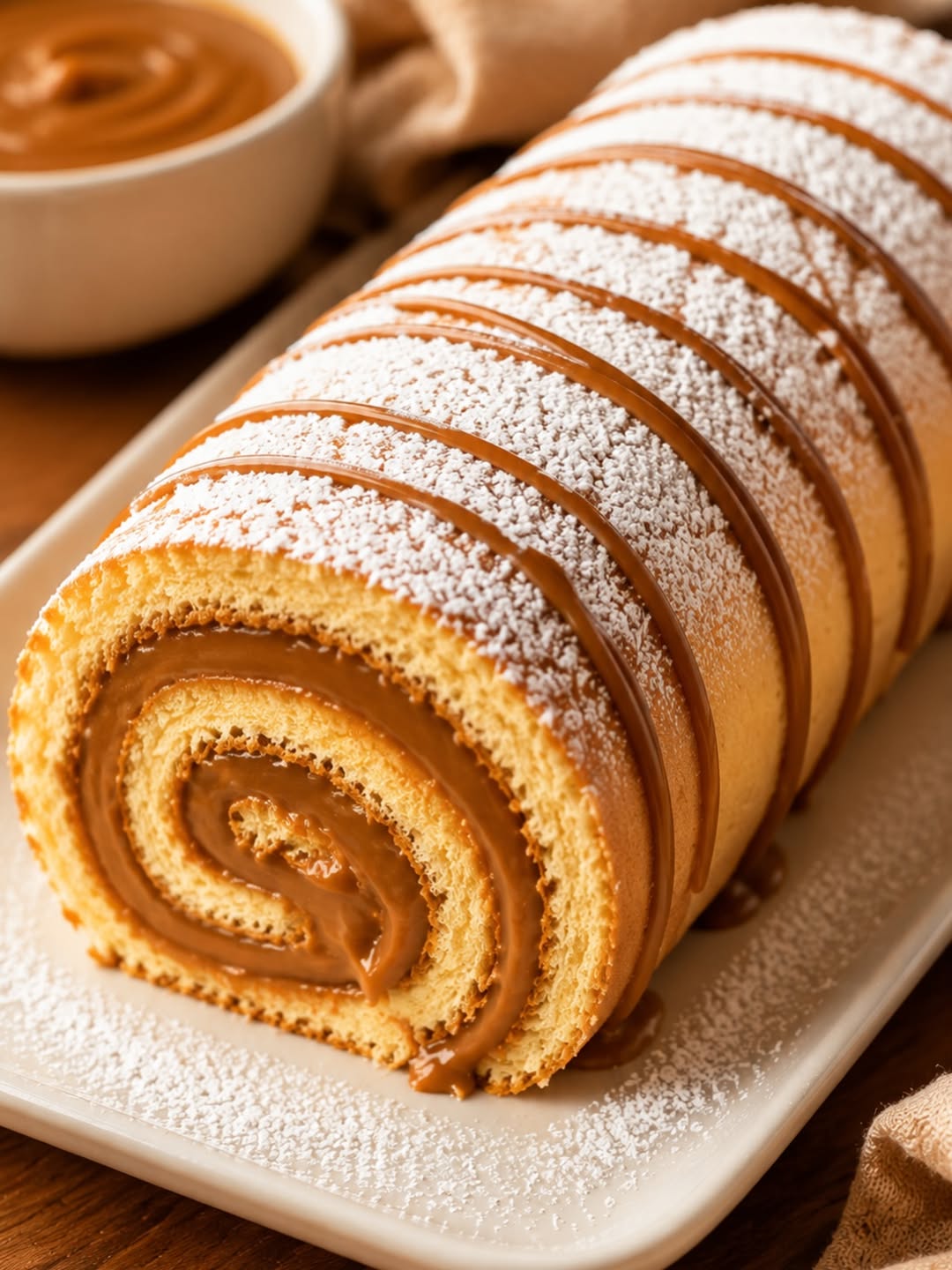
This Rocambole de Doce de Leite is a classic Brazilian cake roll featuring an ultra-light, airy sponge cake wrapped around a rich, decadent filling of creamy dulce de leche. Soft, flexible, and perfectly golden, every elegant slice displays a beautiful spiral pattern, offering a nostalgic and comforting sweetness balanced by a delicate dusting of powdered sugar.
Introduction
The secret to a flawless rocambole lies in creating a highly flexible chiffon-style sponge cake that bends without cracking. By whipping the whole eggs and sugar extensively, you trap air bubbles that expand in the oven, giving the cake its structure without requiring heavy fats. Rolling the sponge inside a damp, sugar-dusted kitchen towel while it is still warm is a crucial technique; it utilizes the trapped residual steam to train the cake’s gluten memory, allowing you to unroll, fill, and reshape it into a beautiful, tight spiral with absolute ease.
Origin and Cultural Significance
The cake roll concept travels back to Central European pastry traditions (commonly known as a Swiss roll or Roulade), but it was enthusiastically embraced and re-imagined across Iberian and Latin American cultures. In Brazil, the rocambole evolved into a quintessential comfort dessert found in neighborhood bakeries (padarias) and served during weekend family lunches. While regional variations feature guava paste (goiabada), the combination with rich, slow-cooked doce de leite (dulce de leche) represents the ultimate expression of South American dessert comfort.
Ingredients Quantity
The Airy Sponge Base
- 5 large eggs (at room temperature)
- 5 tablespoons granulated sugar
- 5 tablespoons all-purpose wheat flour (sifted)
- 1 teaspoon pure vanilla extract (optional)
- 1 teaspoon baking powder (fermento químico em pó)
The Rich Filling
- 400 grams high-quality, spreadable dulce de leche (doce de leite cremoso)
The Finishing Touch
- 2 tablespoons powdered sugar (for dusting, optional)
Optional Additions
- Tropical Coconut Flakes: Scatter ½ cup of unsweetened grated coconut over the dulce de leche layer before rolling it back up for a classic Doce de Leite com Côco finish.
- Toasted Walnut Crunch: Fold ⅓ cup of finely chopped toasted walnuts into the filling to introduce a pleasant, earthy texture that cuts through the sweet dairy notes.
- Cinnamon Sugar Roll: Dust the clean kitchen towel with a mix of granulated sugar and ground cinnamon instead of plain sugar to infuse the outer crust with a warm bakery aroma.
Tips for Success
- Whip Intensely: Beat the eggs and sugar for at least 5 to 7 minutes. The mixture should become incredibly pale, thick, and triple in volume. This aeration is what makes the sponge light and flexible enough to roll without tearing.
- Do Not Overbake: Watch the cake closely between the 12 and 15-minute mark. If the edges dry out or turn dark brown, the sponge loses its internal moisture and will crack stubbornly when you try to shape it.
- Roll While Warm: Do not let the cake cool down flat on your counter. Turn it out onto your prepared kitchen towel immediately after it leaves the oven, peel off the parchment paper, and roll it up right away to trap the shaping steam.
Instructions
1. Preparation and Aeration
Preheat your oven to 350°F (180°C). Grease a large rectangular baking sheet (approx. 10×15 inches), line the bottom cleanly with parchment paper, and grease the top of the paper as well. In a large bowl or stand mixer, combine the 5 eggs and 5 tablespoons of sugar. Beat on high speed for 5 to 7 minutes until thick, pale, and voluminous.
2. Fold the Dry Ingredients
Add the vanilla extract to the egg foam. Gradually add the sifted flour in small batches, using a silicone spatula to fold it in with wide, gentle, circular movements to preserve the trapped air pockets. Gently fold in the baking powder last.
3. Bake the Sheet
Pour the airy batter onto your prepared baking sheet, using an offset spatula to smooth it into a thin, completely even layer. Bake for 12 to 15 minutes until the top springs back lightly when touched and turns a very pale golden hue.
4. The Initial Steam Roll
While the cake bakes, lay a clean, lint-free kitchen towel flat on your counter and dust its surface uniformly with a tablespoon of granulated sugar. As soon as the cake leaves the oven, invert it directly onto the sugared towel. Carefully peel away the hot parchment paper. Working from the short side, gently roll the warm sponge cake up along with the towel. Let it rest rolled up for 10 to 15 minutes to cool down and set its shape.
5. Fill and Reshape
Carefully and slowly unroll the cooled sponge cake. Using a spatula, spread the 400 grams of creamy dulce de leche evenly across the surface, leaving a small half-inch border at the far edges to prevent the filling from leaking out.
6. Final Roll and Dress
Gently roll the cake back up tightly, this time peeling the kitchen towel away as you advance. Place the completed rocambole seam-side down onto a serving platter. Sift a beautiful, snowy layer of powdered sugar over the top, or decorate it with extra ribbons of dulce de leche. Let it sit for 30 minutes to set before slicing.
Nutritional Information
Serving Size: 1 thick slice (assuming a yield of 10 slices total)
| Nutrient | Amount Per Serving |
| Calories | 245 kcal |
| Total Fat | 5g |
| Saturated Fat | 2.5g |
| Cholesterol | 105mg |
| Sodium | 115mg |
| Total Carbohydrate | 44g |
| Sugars | 34g |
| Protein | 6g |
Recommendation
This classic Brazilian roll cake is exceptional when served alongside a cup of hot, unsweetened black coffee (cafezinho) or a bitter espresso, which beautifully balances the sweet profile of the dulce de leche.
Embracing Healthful Indulgence
Because the sponge cake base is naturally fat-free—relying entirely on egg aeration rather than heavy butter or oils—this dessert is lighter than standard frosted cakes. To adapt it to a lower-glycemic or mindful lifestyle, you can utilize an artisanal sugar-free or low-calorie dulce de leche and swap the white flour for whole-wheat pastry flour to boost dietary fiber.
Conclusion
Rocambole de Doce de Leite shows how basic kitchen physics can turn a minimal ingredient list into an elegant showstopper. By executing a thorough whip of your egg base and respecting the warm-rolling steam technique, you unlock an incredibly tender, pillowy sweet treat that brings authentic Brazilian bakery comfort straight to your dessert table.