
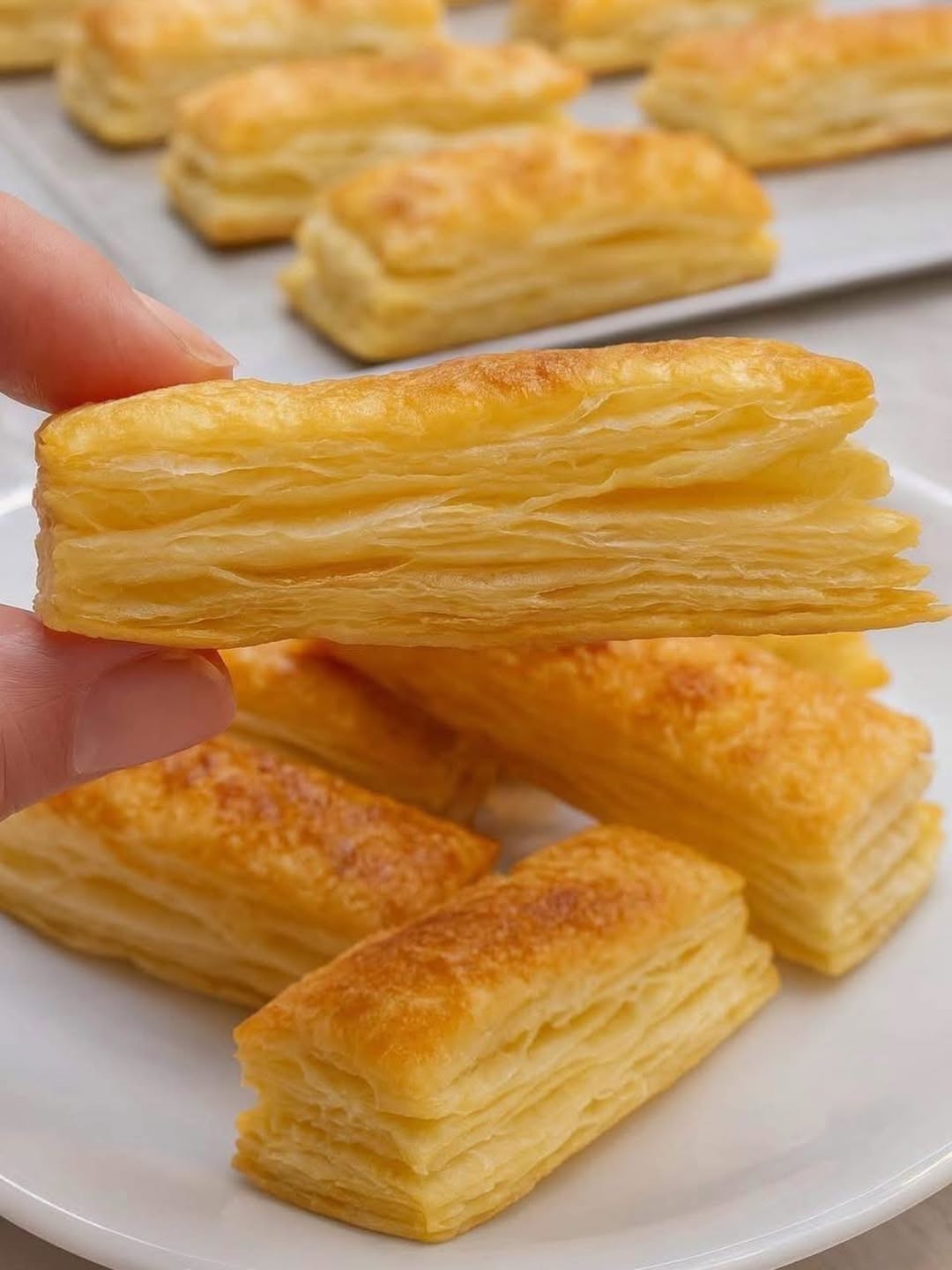
Description
Homemade Puff Pastry (Masa de Hojaldre Casera) is the ultimate crown jewel of classic pastry making. It is a rich, buttery, and incredibly crisp laminated dough that rises beautifully in the oven into dozens of delicate, paper-thin, golden layers. Because it contains no chemical leaveners or yeast, its signature towering puff relies entirely on precision folding, delivering a clean, shatteringly crisp crunch that melts into a rich, buttery finish.
Introduction
Thank you so much for sharing this wonderful, classic recipe! Preparing a traditional puff pastry from scratch is a deeply rewarding culinary milestone. The fascinating science behind a true hojaldre comes down to thermodynamics. By sealing a flat block of solid, cold butter inside a basic flour-and-water dough (détrempe) and rolling it out through a series of geometric folds, you create hundreds of alternating micro-layers of fat and dough. When placed into a hot oven, the moisture trapped inside the butter turns to steam, forcefully pushing the dough layers upward before the flour cooks through, producing an incomparable, flaky lift.
Origin and Cultural Significance
While laminated dough concepts trace back to ancient Middle Eastern layers like phyllo, the method for modern puff pastry was refined in 17th-century France, often attributed to painter and apprentice cook Claude Lorrain, and later perfected by the legendary chef Marie-Antoine Carême. Carême systematized the precise method of “turns” still used today. This technique spread rapidly across Europe and Latin America, becoming the foundational architecture for beloved pastries such as milhojas (napoleons), palmeritas, savory meat pies (empanadas de hojaldre), and elegant tarts.
Ingredients Quantity
The Flour Base (Détrempe)
- 500 grams all-purpose wheat flour (harina de trigo todo uso)
- 1 teaspoon fine salt
- 1 teaspoon granulated sugar
- 250 ml ice-cold water (added gradually)
The Lamination Block (Beurrage)
- 350 grams high-quality unsalted butter (firm and cold)
Finishing Touch
- 1 large egg (beaten, for egg wash / barnizar, optional)
Optional Additions
- Lemon Zest Infusion: Rub the finely grated zest of half a lemon into the dry flour before adding water to introduce a bright, delicate aroma to your pastry sheets.
- Savory Herb Layer: Dust a very fine layer of dried thyme or rubbed oregano over the dough during the final fold to complement savory fillings like cheese or ham.
- Vanilla Sugar Glaze: Brush the baked, hot pastry with a simple syrup infused with pure vanilla extract for a glossy, professional bakery sheen.
Tips for Success
- Match Temperatures Perfectly: Your dough and your butter block must be at the exact same consistency and coolness before you bring them together. If the butter is too warm, it will melt directly into the dough; if it is too cold, it will break into hard chunks under your rolling pin and tear the layers.
- Keep the Rolling Surface Cool: Work on a cold countertop if possible, and dust with just enough flour to prevent sticking. If you feel the dough getting soft or sticky at any point during your 4 to 6 turns, stop rolling immediately, wrap the dough in plastic, and return it to the freezer for 10 minutes.
- Cut with a Sharp Knife: When cutting your finished puff pastry sheet into shapes, always use a razor-sharp knife or pizza wheel and slice straight down. Never drag the blade or pinch the edges of the dough, as this seals the exposed micro-layers together and prevents the pastry from puffing evenly up the sides.
Instructions
1. Build the Dough Base
In a deep bowl, combine the sifted all-purpose flour, fine salt, and sugar. Pour the ice-cold water into the flour gradually, mixing gently with your fingertips just until the ingredients clump together into a smooth, cohesive dough ball. Avoid overworking or kneading heavily to prevent tightening the gluten. Wrap securely in plastic film and chill in the refrigerator for 30 minutes.
2. Prepare the Butter Block
Place the 350 grams of cold butter between two large sheets of parchment paper or waxed paper. Using a heavy rolling pin, beat and roll the cold butter firmly until it flattens out into an even, compact rectangle about a half-inch thick. Slide this butter block into the refrigerator to ensure it remains cool.
3. Enclose the Butter
Roll your chilled dough out onto a lightly floured surface into a large square that is roughly double the size of your butter block. Place the cold butter rectangle diagonally in the exact center of the dough. Fold the four exposed corners of the dough inward over the butter like an envelope, pressing the seams firmly together to seal the butter completely inside.
4. Perform the Folds (The Turns)
Gently tap the dough package with your rolling pin to flatten it, then roll it outward lengthwise into a long, even rectangle. Fold the dough into thirds like a business letter (a simple single turn). Rotate the dough 90 degrees, roll it out lengthwise again, and fold it into thirds a second time. Wrap the dough tightly in plastic and refrigerate for 30 minutes.
5. Repeat and Build Layers
Remove the chilled dough from the refrigerator. Repeat the process of rolling it into a long rectangle, folding it into thirds, and resting it in the cold for 30 minutes. Complete this cycle until you have achieved 4 to 6 total folds. This meticulous process builds up the hundreds of distinct layers. Keep the finished dough wrapped and refrigerated for at least 1 hour (or overnight) before your final bake.
6. Shape and Cut
Roll the rested puff pastry out gently on a floured surface to your desired thickness (typically about 4 mm or 1/8 inch thick). Use a sharp knife to cut the pastry into your desired shapes for tarts, pastries, or turnovers. Place the shaped pieces onto a baking sheet lined with parchment paper. If desired, lightly brush the tops with a beaten egg wash, keeping it completely away from the cut edges.
7. Bake to a Majestic Puff
Preheat your oven thoroughly to 400°F (200°C). Slide the baking sheet onto the middle rack. Bake for 18 to 25 minutes. Watch the pastry closely through the oven window; it should rise dramatically and blossom into clean layers. Once the crust turns a rich, uniform golden-brown, remove from the oven and let cool completely on a wire rack.
Nutritional Information
Serving Size: 1 standard portion of baked pastry (approx. 50g)
| Nutrient | Amount Per Serving |
|---|---|
| Calories | 220 kcal |
| Total Fat | 15g |
| Saturated Fat | 9.5g |
| Cholesterol | 40mg |
| Sodium | 120mg |
| Total Carbohydrate | 18g |
| Dietary Fiber | 0.6g |
| Sugars | 0.5g |
| Protein | 3g |
Recommendation
This multi-purpose puff pastry is an extraordinary canvas for both sweet and savory creations. It makes a spectacular base for a fresh fruit galette, crisp palmiers, or savory mushroom-and-cheese turnovers. Serve your baked creation alongside a cup of hot espresso or a light afternoon tea.
Embracing Healthful Indulgence
Puff pastry is a celebrated, technique-driven culinary art that relies on quality fats for its structure. To integrate this beautiful creation into a mindful lifestyle, focus on clean portion control by cutting the pastry into bite-sized appetizers (vol-au-vents or mini tarts), fill the centers with nutrient-dense toppings like roasted asparagus, fresh berries, or lean shredded chicken, and enjoy the incredibly light, crisp texture alongside a high-fiber green salad.
Conclusion
Homemade puff pastry proves that time, patience, and precise temperature management can turn everyday baking staples into an exquisite, multi-layered masterpiece. By respecting the resting periods to keep your butter cold and sharp, you unlock a breathtakingly light, professional-grade hojaldre that elevates any kitchen creation into an elegant dining experience.