
1. Introduction
Nothing compares to the wonderful aroma of freshly baked Homemade Cinnamon Rolls with Cream Cheese Frosting filling your kitchen.
These soft, fluffy rolls feature tender homemade yeast dough wrapped around a rich cinnamon and brown sugar filling. Once baked to a beautiful golden color, they are generously covered with smooth, creamy cream cheese frosting.
Every bite combines buttery pastry, warm cinnamon, sweet brown sugar, and a deliciously tangy frosting.
Although homemade cinnamon rolls require some rising time, the preparation is straightforward and uses familiar baking ingredients.
Perfect for a special breakfast, weekend brunch, or comforting homemade dessert, these cinnamon rolls are a wonderful treat to share with family and friends.
With a little patience and a few simple techniques, you can create bakery-style cinnamon rolls right in your own kitchen.
2. Origin and Cultural Significance
Cinnamon rolls have a long history in European baking, particularly in Northern Europe, where sweet yeast breads flavored with cinnamon became popular.
Swedish kanelbullar, or cinnamon buns, are among the best-known traditional versions.
Over time, cinnamon rolls became especially popular in North America, where larger, softer rolls with sweet frostings developed into a familiar bakery favorite.
The American-style cinnamon roll often features a rich yeast dough, a generous cinnamon-sugar filling, and a thick glaze or cream cheese frosting.
Today, homemade cinnamon rolls are enjoyed as breakfast pastries, brunch treats, and desserts.
Their soft texture, sweet aroma, and beautiful spiral appearance make them a favorite for gatherings and relaxed weekend baking.
3. Ingredients
This recipe makes 12 medium cinnamon rolls in a 9×13-inch baking pan.
For the Soft Yeast Dough
- ¾ cup (180ml) whole milk, warmed to approximately 105–110°F (40–43°C)
- 2¼ teaspoons (7g) active dry or instant yeast
- ⅓ cup (65g) granulated sugar
- 2 large eggs, at room temperature
- ⅓ cup (75g) unsalted butter, melted and slightly cooled
- 3½ cups (420g) all-purpose flour
- 1 teaspoon fine salt
For the Cinnamon Sugar Filling
- ⅓ cup (75g) unsalted butter, softened to room temperature
- ¾ cup (150g) packed light brown sugar
- 2 tablespoons ground cinnamon
For the Cream Cheese Frosting
- 4 oz (115g) full-fat brick cream cheese, softened
- ¼ cup (55g) unsalted butter, softened
- 1½ cups (180g) powdered sugar, sifted
- 1 teaspoon pure vanilla extract
- 1–2 tablespoons heavy cream or milk, as needed
Optional Finishing Touches
- A light dusting of cinnamon
- A little extra powdered sugar
- Chopped toasted pecans or walnuts
4. Optional Additions
These cinnamon rolls are delicious as written, but you can customize them with a few simple ingredients.
Chopped Pecans: Sprinkle ⅓ cup finely chopped pecans over the cinnamon filling before rolling the dough.
Walnuts: Add ¼–⅓ cup chopped walnuts for a slightly different nutty flavor.
Orange Zest: Mix 1 teaspoon finely grated orange zest into the frosting for a bright citrus note.
Extra Vanilla: Add another ½ teaspoon vanilla extract to the frosting for a stronger aroma.
Maple Frosting: Replace a small amount of the milk with pure maple syrup for a subtle maple flavor.
Caramel Drizzle: Add a thin drizzle of caramel sauce over the frosted rolls for extra sweetness.
5. Tips for Success
Use warm, not hot, milk. Milk around 105–110°F (40–43°C) is suitable for activating active dry yeast. Excessively hot liquid can damage the yeast.
Check your yeast. Active dry yeast should begin showing signs of activity after several minutes in warm milk with a little sugar. Instant yeast can also be used, although it does not require a separate activation step.
Avoid adding too much flour. The dough should feel soft and slightly tacky. Adding excessive flour can produce dry, dense rolls.
Knead until elastic. Proper kneading develops the dough’s structure and helps create fluffy cinnamon rolls.
Allow enough rising time. Dough rises at different speeds depending on room temperature. Look for a noticeable increase in size rather than following the clock exactly.
Use softened filling butter. Butter that is soft but not melted spreads evenly without soaking into the dough.
Roll the dough evenly. A consistent rectangular shape helps create uniform cinnamon spirals.
Cut the rolls gently. Unflavored dental floss or a sharp serrated knife can help prevent the rolls from becoming squashed.
Avoid overbaking. Cinnamon rolls should be lightly golden and cooked through while remaining soft in the center.
Frost while warm, not extremely hot. Allowing the rolls to cool for 5–10 minutes lets the frosting soften slightly without completely melting.
6. Instructions
Part 1: Prepare the Yeast Dough
Step 1: Warm the Milk
Pour the whole milk into a small saucepan or microwave-safe bowl.
Warm gently until it reaches approximately 105–110°F (40–43°C).
The milk should feel pleasantly warm, not hot.
Step 2: Activate the Yeast
Pour the warm milk into the bowl of a stand mixer.
Add the yeast and 1 tablespoon of the measured granulated sugar.
Stir gently and allow the mixture to rest for 5–10 minutes.
If using active dry yeast, the mixture should begin looking foamy or bubbly.
If using instant yeast, you can proceed without waiting for a pronounced foam layer.
Step 3: Add the Remaining Wet Ingredients
Add the remaining granulated sugar to the yeast mixture.
Crack in the two eggs.
Pour in the melted butter, making sure it has cooled enough that it is no longer hot.
Add the salt.
Whisk everything together until combined.
Step 4: Add the Flour
Attach the dough hook to your stand mixer.
Gradually add the all-purpose flour while mixing on low speed.
Continue mixing until the dough begins forming a soft mass.
The dough should pull away from most of the bowl’s sides but may remain slightly sticky at the bottom.
Step 5: Knead the Dough
Knead using the dough hook for approximately 5–7 minutes.
The dough should become smooth, elastic, and slightly tacky.
If it is extremely sticky and cannot hold its shape, add a little additional flour, one tablespoon at a time.
Avoid adding more flour than necessary.
If kneading by hand, work the dough on a lightly floured surface for approximately 8–10 minutes.
Part 2: First Rise
Step 6: Prepare the Rising Bowl
Lightly grease a large mixing bowl with a little neutral oil or softened butter.
Transfer the dough into the bowl and turn it once to coat the surface lightly.
Step 7: Cover the Dough
Cover the bowl with plastic wrap or a clean, slightly damp kitchen towel.
Place it in a warm, draft-free location.
Step 8: Allow the Dough to Rise
Let the dough rise for approximately 1–1½ hours, or until it has roughly doubled in volume.
Depending on your kitchen temperature, it may take slightly longer.
The dough should look soft, airy, and visibly expanded.
Part 3: Prepare the Cinnamon Filling
Step 9: Combine the Cinnamon and Sugar
In a small mixing bowl, combine:
- Packed light brown sugar
- Ground cinnamon
Stir thoroughly until the cinnamon is evenly distributed through the sugar.
Set aside.
Step 10: Prepare the Butter
Make sure the filling butter is soft enough to spread easily.
It should be creamy but not melted.
Part 4: Roll and Fill the Dough
Step 11: Prepare the Work Surface
Lightly flour a clean work surface.
Transfer the risen dough onto it.
Gently press the dough to release some of the trapped air.
Step 12: Roll the Dough
Using a rolling pin, roll the dough into a rectangle approximately 12×18 inches.
Try to keep the thickness as even as possible.
If the dough keeps shrinking back, let it rest for 5–10 minutes before continuing.
Step 13: Spread the Butter
Using an offset spatula or the back of a spoon, spread the softened butter evenly over the dough.
Leave a small border along one long edge to help seal the roll.
Step 14: Add the Cinnamon Sugar
Sprinkle the cinnamon and brown sugar mixture evenly over the buttered surface.
Gently press the filling into the butter with your hands or a spatula.
This helps keep the filling in place when rolling.
Step 15: Roll into a Log
Starting from one of the long edges, roll the dough into a tight log.
Roll steadily without stretching the dough too aggressively.
Pinch the final seam closed to help prevent the roll from opening during baking.
Part 5: Slice and Second Rise
Step 16: Cut the Cinnamon Rolls
Using a sharp serrated knife or a long piece of unflavored dental floss, cut the log into 12 equal pieces, approximately 1½ inches thick.
For clean slices with dental floss, slide the floss underneath the log, cross the ends over the top, and pull gently.
Step 17: Prepare the Baking Pan
Lightly grease a 9×13-inch baking pan with butter or nonstick cooking spray.
Arrange the cinnamon rolls cut-side up in the pan.
A 3-by-4 arrangement works well.
Leave a small amount of space between the rolls so they have room to rise.
Step 18: Allow the Second Rise
Cover the pan loosely with plastic wrap or a clean kitchen towel.
Let the rolls rise for approximately 30–45 minutes, or until noticeably puffy and beginning to touch one another.
Avoid letting them rise excessively, which can weaken their structure.
Part 6: Bake the Cinnamon Rolls
Step 19: Preheat the Oven
Toward the end of the second rise, preheat your oven to 350°F (175°C).
Position an oven rack in the center.
Step 20: Bake Until Lightly Golden
Remove the covering from the rolls.
Place the baking pan in the preheated oven.
Bake for approximately 25–30 minutes, checking around the 20-minute mark.
The rolls are ready when their tops are lightly golden and the centers are fully baked.
For a more reliable doneness check, an instant-read thermometer inserted into the dough portion of a center roll should register approximately 190°F (88°C).
If the tops begin browning too quickly, loosely cover the pan with aluminum foil.
Step 21: Cool Briefly
Remove the cinnamon rolls from the oven.
Let them rest in the pan for approximately 5–10 minutes before adding the frosting.
The rolls should still be warm but no longer extremely hot.
Part 7: Prepare the Cream Cheese Frosting
Step 22: Beat the Butter and Cream Cheese
Place the softened butter in a mixing bowl.
Beat with an electric mixer until smooth.
Add the softened cream cheese.
Mix until fully combined and creamy.
Avoid excessive beating, which can make the frosting too loose.
Step 23: Add the Powdered Sugar
Gradually add the sifted powdered sugar.
Mix on low speed until incorporated.
Add the vanilla extract.
Continue mixing just until smooth.
Step 24: Adjust the Frosting Consistency
Add 1 tablespoon heavy cream or milk.
Mix gently.
If the frosting is too thick to spread, add a little more cream or milk until it reaches your preferred consistency.
The finished frosting should be silky, creamy, and thick enough to spread generously over the rolls.
Part 8: Frost and Serve
Step 25: Spread the Frosting
Spoon the cream cheese frosting over the warm cinnamon rolls.
Use a spatula to spread it evenly.
The warmth of the rolls will soften the frosting slightly, allowing it to settle into the cinnamon swirls.
For a thicker frosting layer, wait until the rolls have cooled a little longer before spreading.
Step 26: Garnish and Serve
If desired, sprinkle a little ground cinnamon or chopped nuts over the frosting.
Serve the cinnamon rolls while slightly warm.
Enjoy the soft dough, sweet cinnamon filling, and rich cream cheese frosting together.
7. Description
Homemade Cinnamon Rolls with Cream Cheese Frosting are soft, fluffy pastries filled with a rich mixture of cinnamon, brown sugar, and butter.
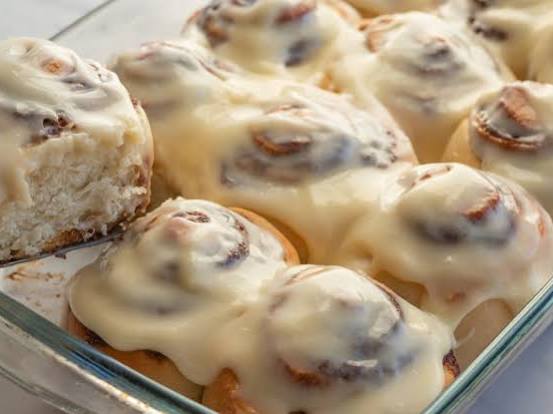
The yeast dough creates a light, tender texture with beautifully defined swirls.
During baking, the cinnamon-sugar filling melts into the layers, producing a sweet, aromatic center.
The rolls develop lightly golden tops while remaining soft and pillowy inside.
A generous coating of cream cheese frosting adds creamy richness and a gentle tanginess that balances the sweetness.
The finished rolls have an inviting bakery-style appearance, with visible cinnamon spirals and smooth frosting spreading across the warm pastry.
Every bite combines soft dough, buttery cinnamon filling, and sweet cream cheese frosting.
8. Nutritional Information
The following values are approximate estimates for one of 12 cinnamon rolls, including the cream cheese frosting.
| Nutrient | Approximate Amount Per Roll |
|---|---|
| Calories | 400–500 kcal |
| Carbohydrates | 55–70 g |
| Protein | 6–8 g |
| Total Fat | 18–24 g |
| Saturated Fat | 10–14 g |
| Sugar | 28–38 g |
| Fiber | 1–2 g |
Actual nutrition will depend on the size of each roll, the amount of frosting used, and the specific ingredients selected.
9. Recipe Details
- Recipe Name: Homemade Cinnamon Rolls with Cream Cheese Frosting
- Cuisine: American-Style Baking
- Course: Breakfast / Brunch / Dessert
- Difficulty: Intermediate
- Yield: 12 cinnamon rolls
- Preparation Time: Approximately 30 minutes
- First Rise: 1–1½ hours
- Second Rise: 30–45 minutes
- Baking Time: Approximately 25–30 minutes
- Cooling and Frosting Time: Approximately 10–15 minutes
- Total Time: Approximately 2½–3½ hours, depending on rising conditions
- Oven Temperature: 350°F (175°C)
- Baking Pan: 9×13 inches
- Main Ingredients: Flour, yeast, milk, eggs, butter, cinnamon, brown sugar, and cream cheese
10. Conclusion
Homemade Cinnamon Rolls with Cream Cheese Frosting are a wonderful example of how simple baking ingredients can create a comforting, delicious treat.
The soft yeast dough, buttery cinnamon-sugar filling, and rich cream cheese frosting combine to produce rolls that are fluffy, flavorful, and beautifully golden.
Although the recipe requires time for the dough to rise, the preparation itself is straightforward and rewarding.
Whether served for breakfast, brunch, or dessert, these homemade cinnamon rolls are sure to become a favorite.
11. Recommendation
For the best results, use fresh yeast and allow the dough to rise until noticeably expanded.
Avoid adding too much flour during kneading, as a soft, slightly tacky dough produces more tender cinnamon rolls.
Roll the dough into an even rectangle and distribute the cinnamon filling carefully so each roll contains a consistent amount.
For especially soft rolls, avoid overbaking and remove them once the centers are fully cooked.
Serving Suggestions
These cinnamon rolls pair beautifully with:
- Freshly brewed coffee
- Hot tea
- Warm milk
- Fresh berries
- Sliced fruit
Storage Tips
Refrigeration: Because the rolls are topped with cream cheese frosting, store leftovers in an airtight container in the refrigerator for up to 3–4 days.
Freezing: For best results, freeze the baked cinnamon rolls without frosting. Wrap them tightly and freeze for up to 2–3 months.
Reheating: Warm refrigerated rolls gently in the microwave for approximately 10–20 seconds, checking frequently. Avoid overheating, which can dry out the dough and cause the frosting to melt excessively.
Make-Ahead Option: Assemble the cut rolls in the baking pan, cover tightly, and refrigerate overnight. The following day, let them stand at room temperature until noticeably puffy before baking. This may take 45–90 minutes or longer, depending on the dough temperature.
12. Embracing Healthful Indulgence
Homemade Cinnamon Rolls with Cream Cheese Frosting are a rich, sweet treat best enjoyed as an occasional indulgence.
The dough provides carbohydrates, while butter and cream cheese contribute the signature richness and creamy texture.
Cinnamon adds warm flavor and aroma without requiring additional sweeteners.
For a lighter variation, you can reduce the amount of frosting used or divide the dough into smaller portions.
You can also serve a cinnamon roll alongside fresh fruit for a more balanced breakfast or brunch.
Ultimately, homemade cinnamon rolls are about more than sweetness. Their wonderful aroma, soft texture, and beautiful spirals make baking and sharing them a memorable experience.
With their fluffy dough, gooey cinnamon filling, and silky cream cheese frosting, these cinnamon rolls are a comforting homemade favorite worth enjoying.