
Prep Time: 25 minutes Cook Time: 15–20 minutes Total Time: Approximately 45 minutes Servings: 2–3 Yield: 2 large rolls Difficulty: Intermediate Category: Japanese-Inspired Cuisine, Seafood, Crispy Rolls, Fusion Food
1. Introduction
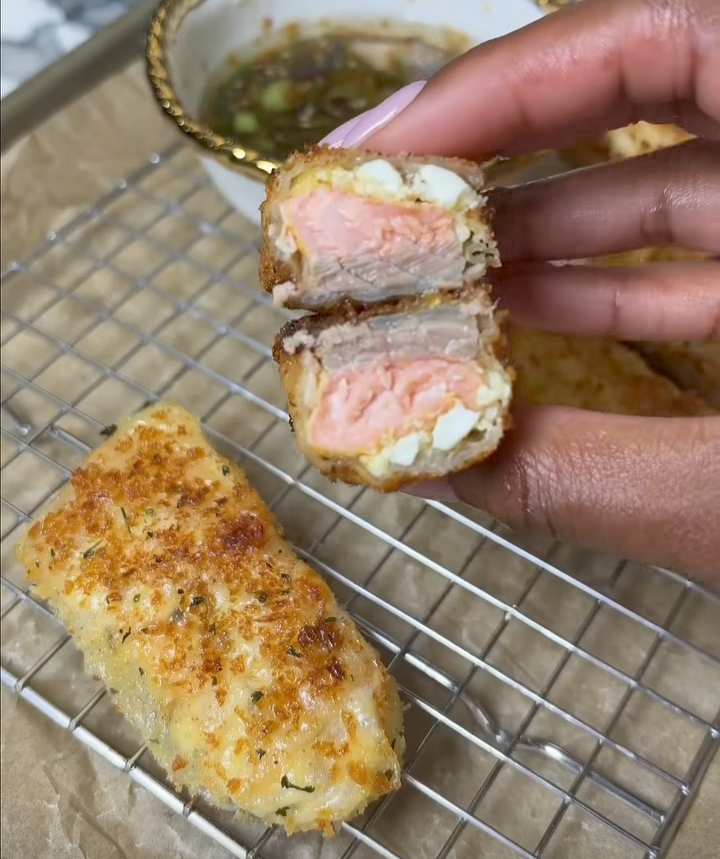
The Ultimate Crispy Salmon & Egg Salad Meat-Wrapped Katsu Roll is a creative fusion dish that combines delicate seafood, creamy egg salad, savory thinly sliced meat, and an exceptionally crunchy golden panko coating.
This impressive preparation features several distinct layers carefully assembled into one delicious roll. At its center, thick pieces of fresh salmon provide a tender, buttery seafood flavor. A creamy egg salad made with finely chopped hard-boiled eggs and Japanese Kewpie mayonnaise introduces richness and a smooth texture.
The salmon and egg salad are wrapped in paper-thin slices of pork loin or beef, creating a savory outer layer that holds the filling together.
The assembled roll is then coated in seasoned flour, beaten eggs, and Japanese-style panko breadcrumbs before being fried until beautifully golden and crispy.
The final result is a crunchy exterior surrounding a tender salmon center and creamy egg filling.
A homemade soy-ponzu dipping sauce, prepared with soy sauce, rice vinegar, sesame oil, and fresh green onions, adds a refreshing salty and tangy contrast to the richness of the fried roll.
Perfect for an impressive lunch, special dinner, entertaining guests, or experimenting with Japanese-inspired fusion cooking, this recipe transforms simple ingredients into a visually striking gourmet dish.
2. Origin and Cultural Significance
The Crispy Salmon & Egg Salad Meat-Wrapped Katsu Roll is a modern fusion-inspired preparation rather than a traditional Japanese dish. However, several of its techniques and ingredients are closely connected to Japanese culinary traditions.
One of its most important influences is Tonkatsu, a popular Japanese dish consisting of breaded and deep-fried pork cutlets.
Tonkatsu developed during the late nineteenth and early twentieth centuries as Japanese cuisine incorporated Western-style cooking techniques. The dish became particularly popular because of its crispy coating, tender interior, and satisfying flavor.
Japanese panko breadcrumbs are essential to many katsu preparations. Unlike conventional fine breadcrumbs, panko consists of larger, lighter flakes that produce an airy and exceptionally crunchy crust when fried.
Another important influence is Japanese egg salad, often prepared with hard-boiled eggs and Kewpie mayonnaise.
Kewpie mayonnaise is particularly popular in Japan because of its rich, creamy consistency and distinctive savory flavor. It is frequently used in sandwiches, salads, and other everyday preparations.
Salmon also holds an important place in Japanese food culture, appearing in sushi, grilled fish preparations, rice bowls, and numerous seafood dishes.
The dipping sauce takes inspiration from ponzu, a Japanese condiment traditionally combining citrus juice, soy sauce, and other ingredients. Its bright acidity provides an excellent contrast to fried foods.
The use of thinly sliced pork or beef as an outer wrapping introduces another interesting technique, combining the concept of Japanese-style meat rolls with the crispy preparation of katsu.
Although this particular combination is a contemporary culinary interpretation, it brings together familiar Japanese ingredients and techniques in a creative new format.
Today, fusion dishes like this demonstrate how traditional cooking methods can be adapted to produce innovative textures, flavors, and presentations.
3. Ingredients and Quantities
A. For the Salmon Core
| Ingredient | Quantity |
|---|---|
| Fresh skinless salmon fillets | 2 |
| Fine salt | ¼ teaspoon |
| Ground white or black pepper | ¼ teaspoon |
| Lemon juice (optional) | 1 teaspoon |
Why Use Fresh Salmon?
Salmon provides a tender, naturally rich seafood center with a delicate flavor that complements the creamy egg salad.
Choose boneless, skinless fillets and cut them into thick rectangular pieces to create evenly shaped rolls.
Why Use Salt and Pepper?
A light seasoning enhances the natural flavor of the salmon without overpowering the other ingredients.
B. For the Thin Meat Wrapping
| Ingredient | Quantity |
|---|---|
| Very thinly sliced pork loin or beef | 4–6 slices |
| Fine salt | A small pinch, if needed |
| Ground black pepper | A small pinch |
Why Use Thinly Sliced Meat?
Thinly sliced pork or beef creates a flexible outer layer that can wrap around the salmon and egg salad.
It also contributes additional savory flavor and helps hold the internal layers together during breading and frying.
For easier assembly, choose slices that are thin, flexible, and large enough to overlap around the filling.
C. For the Creamy Egg Salad Filling
| Ingredient | Quantity |
|---|---|
| Large eggs, hard-boiled | 2 |
| Kewpie mayonnaise | 1½ tablespoons |
| Fine salt | A small pinch |
| Ground white pepper | A small pinch |
Why Use Hard-Boiled Eggs?
Hard-boiled eggs provide a creamy yet slightly firm filling that adds protein and richness.
Why Use Kewpie Mayonnaise?
Kewpie mayonnaise has a rich, smooth consistency and a distinctive savory flavor that complements both the salmon and meat wrapping.
Why Use White Pepper?
White pepper provides gentle seasoning without introducing visible black specks into the pale egg salad.
D. For the Crispy Panko Breading Station
| Ingredient | Quantity |
|---|---|
| All-purpose flour | ½ cup (approximately 60 g) |
| Large eggs | 2 |
| Panko breadcrumbs | 1½ cups (approximately 75 g) |
| Dried parsley | 1 teaspoon |
| Grated Parmesan cheese (optional) | 2 tablespoons |
| Fine salt | A small pinch |
| Ground black pepper | A small pinch |
Why Use Panko Breadcrumbs?
Panko breadcrumbs create a lighter and crunchier coating than traditional fine breadcrumbs.
Their larger flakes produce the characteristic irregular, golden crust associated with Japanese-style katsu.
Why Add Dried Parsley?
Dried parsley adds a subtle herbal flavor and enhances the appearance of the breading.
Why Add Parmesan?
Parmesan introduces a savory, slightly nutty flavor and contributes additional browning.
E. For the Soy-Ponzu Inspired Dipping Sauce
| Ingredient | Quantity |
|---|---|
| Soy sauce or prepared ponzu | 3 tablespoons |
| Rice vinegar | 1 tablespoon |
| Sesame oil | 1 teaspoon |
| Green onions, finely chopped | 1 tablespoon |
Why Use Soy Sauce?
Soy sauce contributes a salty, savory flavor that complements the fried meat and seafood.
Why Use Rice Vinegar?
Rice vinegar provides acidity that balances the richness of the mayonnaise and fried coating.
Why Add Sesame Oil?
Sesame oil contributes a distinctive nutty aroma and enhances the Asian-inspired flavor profile.
Why Use Green Onions?
Green onions introduce freshness, mild sweetness, and a little crunch.
Note: This is a soy-vinegar dipping sauce inspired by ponzu. Traditional ponzu generally includes citrus juice.
F. For Deep Frying
| Ingredient | Quantity |
|---|---|
| Vegetable oil, canola oil, or peanut oil | Approximately 1 liter, as needed |
Use enough oil to submerge the rolls safely in a suitable heavy-bottomed pot.
G. Recommended Equipment
- Large mixing bowls
- Sharp chef’s knife
- Cutting board
- Small saucepan
- Meat mallet
- Plastic wrap
- Kitchen tongs
- Three shallow breading bowls
- Heavy-bottomed pot or Dutch oven
- Deep-frying thermometer
- Wire cooling rack
- Baking sheet
- Meat thermometer
- Paper towels
4. Optional Additions
This creative katsu roll can be customized with additional ingredients to introduce different flavors and textures.
Cream Cheese: Add 1–2 tablespoons of softened cream cheese to the egg salad for an even richer filling.
Dijon Mustard: Add ½ teaspoon to the egg salad for a subtle tangy flavor.
Fresh Chives: Incorporate 1 tablespoon of finely chopped chives for additional herbal freshness.
Avocado: Add a few thin avocado slices alongside the salmon for a buttery texture.
Fresh Dill: Add ½ teaspoon of finely chopped dill to complement the seafood flavor.
Lemon Zest: Incorporate a little lemon zest into the egg salad for a refreshing citrus aroma.
Sriracha: Add ½ teaspoon to the mayonnaise mixture for a spicy variation.
Wasabi: Mix a small amount of wasabi into the dipping sauce for a more pronounced Japanese-inspired heat.
Sesame Seeds: Add 1 tablespoon of toasted sesame seeds to the panko breadcrumbs for extra texture.
Mozzarella Cheese: Add a small strip of mozzarella alongside the salmon for a stretchy, melted center.
Garlic Powder: Incorporate ½ teaspoon into the panko mixture for additional savory flavor.
Smoked Paprika: Add ¼ teaspoon to the breading for a subtle smoky note.
Crispy Onions: Add a small amount of finely crushed crispy onions to the panko for additional crunch.
Sweet Chili Sauce: Serve alongside the soy-based dipping sauce for a sweet and spicy alternative.
Fresh Lime Juice: Add 1 teaspoon to the dipping sauce for additional acidity and freshness.
5. Tips for Success
Choose thick salmon fillets. Uniform rectangular pieces make the rolls easier to assemble and help produce attractive cross-sections.
Remove all bones. Carefully check the salmon for pin bones before cutting it into portions.
Keep the egg salad thick. Excessively runny egg salad can leak during wrapping and frying.
Chill the egg salad. Refrigerating the filling briefly helps it become firmer and easier to handle.
Avoid excessive filling. Use a moderate amount of egg salad so the roll can close securely.
Pound the meat evenly. Thin, uniform meat slices wrap more easily around the salmon.
Overlap the meat slices. Overlapping prevents gaps and helps keep the internal filling enclosed.
Secure the seam properly. Position the seam underneath the roll before breading. Toothpicks can be used if necessary, but remove them before slicing and serving.
Keep the rolls cold before breading. A brief refrigeration period helps the structure remain firm during handling.
Use three separate breading stations. Keep the flour, egg wash, and panko separate to create an even coating.
Press the panko gently. Light pressure helps the breadcrumbs adhere without compressing the coating excessively.
Rest the breaded rolls. Allow approximately 10 minutes of resting time before frying to help the coating adhere.
Maintain a controlled oil temperature. Fry around 325–340°F (163–171°C), adjusting the heat to prevent excessive browning.
Avoid overcrowding the pot. Cook the rolls individually or in small batches to maintain a consistent oil temperature.
Check the internal temperature. The salmon must reach 145°F (63°C). If using pork or beef as the outer wrap, ensure it also reaches a safe temperature of at least 145°F (63°C), followed by a 3-minute rest.
Finish in the oven if necessary. If the exterior browns before the center reaches the required temperature, transfer the rolls to a preheated oven to finish cooking.
Drain on a wire rack. Avoid placing the finished rolls directly on paper towels for extended periods, as trapped steam can soften the crust.
Slice after resting. Allow the rolls to rest briefly before cutting to preserve their layered structure.
6. Step-by-Step Instructions
Part A: Preparing the Egg Salad Filling
Step 1: Boil the Eggs
Place the two large eggs in a small saucepan.
Cover them with cold water, ensuring that the water level is approximately 1 inch above the eggs.
Place the saucepan over medium-high heat and bring the water to a boil.
Once boiling, cover the saucepan, remove it from the heat, and allow the eggs to stand for approximately 10–12 minutes.
Transfer the eggs into a bowl of ice water.
Allow them to cool completely before peeling.
Step 2: Peel and Chop the Eggs
Remove the eggs from the cold water.
Carefully peel away the shells.
Place the eggs on a cutting board.
Using a sharp knife, chop them into small, even pieces.
For a creamier filling, mash some of the egg yolks while leaving small pieces of egg white intact.
This creates a pleasant combination of smooth and slightly chunky textures.
Step 3: Prepare the Egg Salad
Transfer the chopped eggs into a small mixing bowl.
Add:
- 1½ tablespoons Kewpie mayonnaise
- A small pinch of salt
- A small pinch of white pepper
Mix gently until the mayonnaise coats the eggs evenly.
Avoid adding too much mayonnaise because the filling needs to remain thick enough to stay inside the roll.
Step 4: Chill the Egg Salad
Cover the bowl and refrigerate for approximately 10–15 minutes.
This allows the filling to firm slightly, making it easier to distribute around the salmon.
Part B: Preparing the Salmon
Step 5: Prepare the Salmon Fillets
Place the skinless salmon fillets on a clean cutting board.
Check carefully for any remaining pin bones.
Using a sharp knife, remove uneven edges and cut each fillet into a thick rectangular baton.
Aim for pieces approximately 4–5 inches long and 1–1½ inches thick, adjusting according to the size of the meat slices.
The salmon pieces should be relatively uniform so that they cook evenly.
Step 6: Season the Salmon
Place the salmon pieces in a shallow dish.
Season lightly with:
- ¼ teaspoon fine salt
- ¼ teaspoon white or black pepper
- 1 teaspoon lemon juice, optional
Turn the pieces gently to distribute the seasoning.
Avoid using too much lemon juice, as excess moisture can make the outer layers more difficult to assemble.
Pat away any excess surface moisture.
Part C: Preparing the Meat Wrapping
Step 7: Prepare the Thin Meat Slices
Place the pork loin or beef slices between two sheets of plastic wrap.
Using a meat mallet, gently pound the slices until they become very thin and flexible.
Avoid striking too forcefully, as the meat may tear.
Each slice should be large enough to wrap around the salmon and egg salad.
Step 8: Arrange the Meat
Lay the meat slices flat on a clean cutting board.
Arrange two or three slices slightly overlapping to create a continuous wrapping surface for each salmon portion.
If necessary, season very lightly with black pepper.
Avoid excessive salt because the meat, panko coating, and dipping sauce already contribute seasoning.
Part D: Assembling the Multi-Layered Roll
Step 9: Position the Salmon
Place one rectangular salmon baton in the center of the prepared meat slices.
Ensure that the meat extends beyond the salmon on both sides.
This will allow the entire filling to be enclosed.
Step 10: Add the Egg Salad
Take a small amount of chilled egg salad.
Using a spoon, distribute a narrow layer alongside the salmon.
If the shape allows, spread a little over the upper surface of the salmon as well.
Keep the filling relatively compact.
Avoid placing too much egg salad near the edges, as it may escape during wrapping.
Step 11: Wrap the Salmon and Egg Salad
Carefully lift one side of the thin meat slices.
Bring it over the salmon and egg salad.
Continue rolling gently until the filling is completely enclosed.
Overlap the meat slightly at the seam.
Press the edges gently to secure the structure.
Repeat with the second salmon baton.
The finished rolls should be compact and evenly shaped.
Step 12: Chill the Assembled Rolls
Place both assembled rolls on a plate or small tray.
Cover loosely and refrigerate for approximately 10–15 minutes.
This helps the meat maintain its shape and makes the breading process easier.
Part E: Preparing the Crispy Katsu Coating
Step 13: Prepare the Flour
Place ½ cup of all-purpose flour in the first shallow bowl.
Spread it evenly across the bottom.
Step 14: Prepare the Egg Wash
Crack two large eggs into the second shallow bowl.
Whisk thoroughly until the yolks and whites are completely combined.
The mixture should have a uniform consistency.
Step 15: Prepare the Panko Mixture
In the third shallow bowl, combine:
- 1½ cups panko breadcrumbs
- 1 teaspoon dried parsley
- 2 tablespoons grated Parmesan, optional
- A small pinch of salt
- A small pinch of black pepper
Mix thoroughly.
Spread the panko mixture evenly across the bowl.
Step 16: Coat the First Roll in Flour
Remove one assembled roll from the refrigerator.
Place it in the flour bowl.
Turn gently until all surfaces are covered.
Pay particular attention to the ends and the seam.
Shake off excess flour.
Step 17: Dip into the Egg Wash
Transfer the floured roll into the beaten egg mixture.
Turn carefully using kitchen tongs.
Ensure that the entire surface is covered with egg.
Allow excess egg to drip back into the bowl.
Step 18: Coat with Panko Breadcrumbs
Transfer the roll into the seasoned panko mixture.
Turn it carefully until every surface is completely covered.
Use your hands to press the breadcrumbs gently against the meat.
Make sure the ends are also coated.
Repeat the same process with the second roll.
Step 19: Rest the Breaded Rolls
Place the breaded rolls on a clean wire rack.
Allow them to rest for approximately 10 minutes.
This gives the coating time to adhere properly.
For easier handling, keep the rolls refrigerated during this resting period.
Part F: Preparing the Soy-Ponzu Dipping Sauce
Step 20: Combine the Sauce Ingredients
In a small bowl, combine:
- 3 tablespoons soy sauce or ponzu
- 1 tablespoon rice vinegar
- 1 teaspoon sesame oil
- 1 tablespoon finely chopped green onions
Stir thoroughly until combined.
Step 21: Adjust the Flavor
Taste the sauce.
If it is too salty, add a teaspoon of water.
If you prefer a more acidic flavor, add a few additional drops of rice vinegar or lemon juice.
For a little sweetness, add ½ teaspoon of honey.
Stir again and set aside.
The finished dipping sauce should have a balanced combination of salty, tangy, and aromatic flavors.
Part G: Frying the Katsu Rolls
Step 22: Heat the Frying Oil
Pour sufficient vegetable, canola, or peanut oil into a heavy-bottomed pot.
Use enough oil to submerge the rolls while keeping the pot no more than halfway full.
Place the pot over medium heat.
Attach a deep-frying thermometer.
Heat the oil to approximately 325–340°F (163–171°C).
Maintain a controlled temperature throughout frying.
Step 23: Fry the First Roll
Carefully lower one breaded roll into the hot oil using kitchen tongs.
Avoid dropping it into the oil.
Allow the roll to fry for approximately 5–7 minutes, turning carefully to encourage even browning.
The panko coating should gradually develop a golden-brown, crunchy exterior.
Because the rolls contain raw salmon and a meat wrapping, cooking time alone is not sufficient to establish doneness.
Step 24: Monitor the Internal Temperature
Carefully remove the roll from the oil when the crust is golden.
Insert a clean meat thermometer through the end of the roll into the center of the salmon.
The salmon must reach 145°F (63°C).
If the outer wrapping is pork or beef, it must also reach at least 145°F (63°C), followed by a 3-minute rest.
If the coating becomes golden before the center reaches the required temperature, transfer the roll to a preheated oven at 350°F (175°C) and continue cooking until the required internal temperatures are achieved.
Step 25: Fry the Second Roll
Allow the oil to return to the correct temperature.
Carefully add the second roll.
Repeat the frying process, turning gently to ensure even browning.
Check the internal temperature in the same way.
Avoid overcrowding the pot.
Step 26: Drain the Rolls
Once fully cooked, remove the rolls from the oil.
Place them on a wire rack positioned over a baking sheet.
Allow excess oil to drain.
Avoid stacking the rolls, as this can trap steam and soften the crispy coating.
Step 27: Allow the Rolls to Rest
Let the cooked rolls rest for approximately 3 minutes.
This helps stabilize the internal layers and makes slicing easier.
Do not leave them for too long, as the crust is best enjoyed while freshly fried.
Part H: Slicing and Presentation
Step 28: Prepare the Serving Board
Choose a clean wooden serving board or large ceramic plate.
Place the whole crispy rolls on the board.
Ensure that the golden exterior remains visible.
Step 29: Slice the Katsu Rolls
Using a sharp serrated knife, carefully slice each roll diagonally into thick pieces.
Use gentle sawing movements to avoid crushing the panko crust.
Wipe the knife between cuts if necessary.
The cross-section should reveal the distinct layers of salmon, creamy egg salad, and thinly wrapped meat.
Step 30: Arrange the Slices
Arrange the sliced pieces in a row or slightly overlapping pattern.
Position some slices upright to showcase their colorful interiors.
The golden panko coating should surround the filling evenly.
Step 31: Add the Dipping Sauce
Pour the prepared soy-ponzu inspired sauce into a small dipping bowl.
Place it alongside the sliced katsu rolls.
Garnish with finely chopped green onions and a few sesame seeds if desired.
Step 32: Serve Immediately
Serve the crispy rolls while warm.
Each bite should combine the crunchy panko coating, savory meat wrapping, tender salmon, and creamy egg salad.
Dip each slice lightly into the soy-based sauce to introduce a refreshing salty and tangy contrast.
7. Description
The Ultimate Crispy Salmon & Egg Salad Meat-Wrapped Katsu Roll is an innovative fusion dish that combines multiple layers of flavor and texture in one impressive preparation.
At its center, thick salmon batons provide a tender, delicate seafood component with a naturally rich flavor.
The creamy egg salad, prepared with hard-boiled eggs and Kewpie mayonnaise, introduces a smooth and savory filling.
Surrounding these ingredients is a thin layer of seasoned pork or beef, which adds additional flavor and creates a compact structure.
The entire roll is coated in flour, beaten eggs, and Japanese-style panko breadcrumbs before being fried until golden and exceptionally crispy.
The outer coating develops an irregular crunchy texture, while the interior remains tender and moist when properly cooked.
The accompanying soy-ponzu inspired dipping sauce provides a balance of salty soy sauce, tangy rice vinegar, fragrant sesame oil, and fresh green onions.
When sliced diagonally, the roll reveals an attractive cross-section showcasing the different layers.
The contrast between the crunchy exterior, savory meat, delicate salmon, and creamy egg filling makes this dish particularly appealing.
Perfect for gourmet lunches, creative dinners, special occasions, and impressive homemade meals, this recipe offers an exciting alternative to conventional fried seafood or traditional katsu.
8. Nutritional Information
Estimated Nutritional Values per Serving (Based on 2 Servings):
| Nutrient | Approximate Amount |
|---|---|
| Calories | 650–850 kcal |
| Protein | 40–55 g |
| Carbohydrates | 35–50 g |
| Total Fat | 35–50 g |
| Saturated Fat | 8–14 g |
| Sugar | 2–5 g |
| Fiber | 2–4 g |
| Sodium | 800–1,300 mg |
Note: These are approximate estimates based on two large rolls divided into two servings. Actual values depend on the salmon size, type of meat, quantity of mayonnaise, breadcrumbs, oil absorption, and dipping sauce.
Healthier Preparation Alternatives
Use an Air Fryer: Cook the breaded rolls in an air fryer at approximately 375°F (190°C), turning carefully as needed. Lightly spray the panko coating with cooking oil.
Choose Lean Pork: Use lean pork loin rather than fattier cuts to reduce the overall fat content.
Use Less Mayonnaise: Reduce the Kewpie mayonnaise slightly and add a little plain Greek yogurt for a lighter egg salad.
Choose Whole-Wheat Breadcrumbs: Use whole-grain breadcrumbs if available, while recognizing that the texture will differ from traditional panko.
Add More Vegetables: Include finely chopped spinach, chives, or fresh herbs in the egg salad.
Control the Oil: Maintain the correct frying temperature to reduce unnecessary oil absorption.
Use Low-Sodium Soy Sauce: This helps control the sodium content of the dipping sauce.
Serve Smaller Portions: Pair a smaller portion of the roll with steamed vegetables or a fresh salad.
9. Conclusion
The Ultimate Crispy Salmon & Egg Salad Meat-Wrapped Katsu Roll is a creative and visually impressive fusion dish that combines seafood, creamy egg filling, savory meat, and a crunchy Japanese-inspired coating.
Its distinctive appeal comes from the contrast between the tender salmon center, rich egg salad, thin meat wrapping, and golden panko crust.
The preparation incorporates several cooking techniques, including egg boiling, meat pounding, layered assembly, breading, and deep frying.
Although the recipe involves multiple stages, each step contributes to the final structure, flavor, and texture.
The most important elements include preparing a thick egg salad, wrapping the salmon securely, chilling the assembled rolls, applying an even panko coating, and carefully controlling the frying temperature.
The soy-ponzu inspired dipping sauce completes the dish by providing acidity and savory depth that balance the richness of the fried ingredients.
Whether served as a gourmet main course, an impressive appetizer, or a creative weekend meal, this recipe offers an exciting combination of familiar ingredients presented in an unexpected way.
10. Recommendation
For the best results, choose fresh, thick salmon fillets and high-quality thinly sliced pork or beef.
The meat slices should be sufficiently flexible to wrap securely around the salmon and egg salad without tearing.
Prepare the egg salad in advance and refrigerate it briefly to improve its consistency.
Use Kewpie mayonnaise for its distinctive creamy texture and savory flavor.
Japanese panko breadcrumbs are strongly recommended because they create the characteristic light and crunchy katsu exterior.
During frying, maintain a moderate temperature so the coating develops an even golden color without burning before the interior cooks through.
A meat thermometer is particularly important for this recipe because the salmon and meat wrapping are enclosed inside several layers.
Serving Recommendation: Arrange the sliced rolls diagonally on a large ceramic plate, with the golden panko crust facing upward. Place the soy-ponzu dipping sauce in a small bowl alongside the rolls. Garnish with chopped green onions, sesame seeds, and fresh herbs.
For a complete Japanese-inspired meal, accompany the rolls with steamed jasmine rice, cucumber salad, edamame, or lightly dressed shredded cabbage.
Refrigerator Storage: Store cooked leftovers in an airtight container in the refrigerator at 40°F (4°C) or below. Consume within 1–2 days for best quality because the recipe contains cooked seafood and egg filling.
Reheating: Reheat in an oven or air fryer at 350°F (175°C) until the center reaches 165°F (74°C). This helps restore some of the original crispness.
Freezing: Freezing the assembled raw rolls is not recommended because the egg salad and mayonnaise may change texture during thawing. Cooked rolls can be frozen in airtight packaging for approximately 1–2 months for best quality.
Make-Ahead Recommendation: Prepare the egg salad, cut the salmon, and pound the meat slices in advance. Store the components separately in the refrigerator and assemble the rolls shortly before breading and frying.
Allergen Information: This recipe contains fish, eggs, wheat, soy, and sesame if sesame oil is used. It may also contain dairy if Parmesan is added. Check ingredient labels for additional allergens.
11. Embracing Healthful Indulgence
The Crispy Salmon & Egg Salad Meat-Wrapped Katsu Roll demonstrates how a creative comfort-food preparation can combine several nutrient-rich ingredients with an indulgent crispy coating.
Salmon is an excellent source of high-quality protein and provides omega-3 fatty acids, particularly EPA and DHA, which contribute to normal cardiovascular and neurological functions.
It also supplies important nutrients such as vitamin D, vitamin B12, and selenium.
Eggs provide complete protein, choline, vitamin B12, and other nutrients that support normal bodily functions.
The thin pork or beef wrapping contributes additional protein, iron, zinc, and vitamin B12.
Green onions and fresh parsley introduce aromatic plant compounds and small quantities of vitamins and minerals.
However, the panko coating, mayonnaise, and deep-frying process increase the overall calorie and fat content of the dish.
A balanced approach involves enjoying moderate portions while making thoughtful adjustments to the preparation.
Using an air fryer or oven instead of deep frying can reduce the amount of cooking oil required.
Reducing the mayonnaise or replacing part of it with plain Greek yogurt can also create a lighter egg salad without completely changing its creamy character.
Choosing lean meat and using low-sodium soy sauce helps improve the overall nutritional balance.
Serving the rolls alongside fresh cabbage, cucumber salad, steamed vegetables, or edamame provides additional fiber and dietary variety.
Preparing the recipe at home allows greater control over ingredient quality, seasoning, cooking oil, and portion sizes.
Ultimately, healthful indulgence is about enjoying innovative and satisfying foods while maintaining moderation, nutritional variety, and balance in everyday eating.
Final Thought: 🍣🔥🥚 With its golden, crunchy panko crust, savory meat wrapping, tender salmon center, and luxurious creamy egg salad, the Ultimate Crispy Salmon & Egg Salad Meat-Wrapped Katsu Roll delivers an extraordinary combination of textures and flavors. Finished with a refreshing soy-ponzu inspired dipping sauce, this creative Japanese-inspired fusion dish transforms simple ingredients into an impressive gourmet experience perfect for special dinners and memorable homemade meals.