
1. Introduction
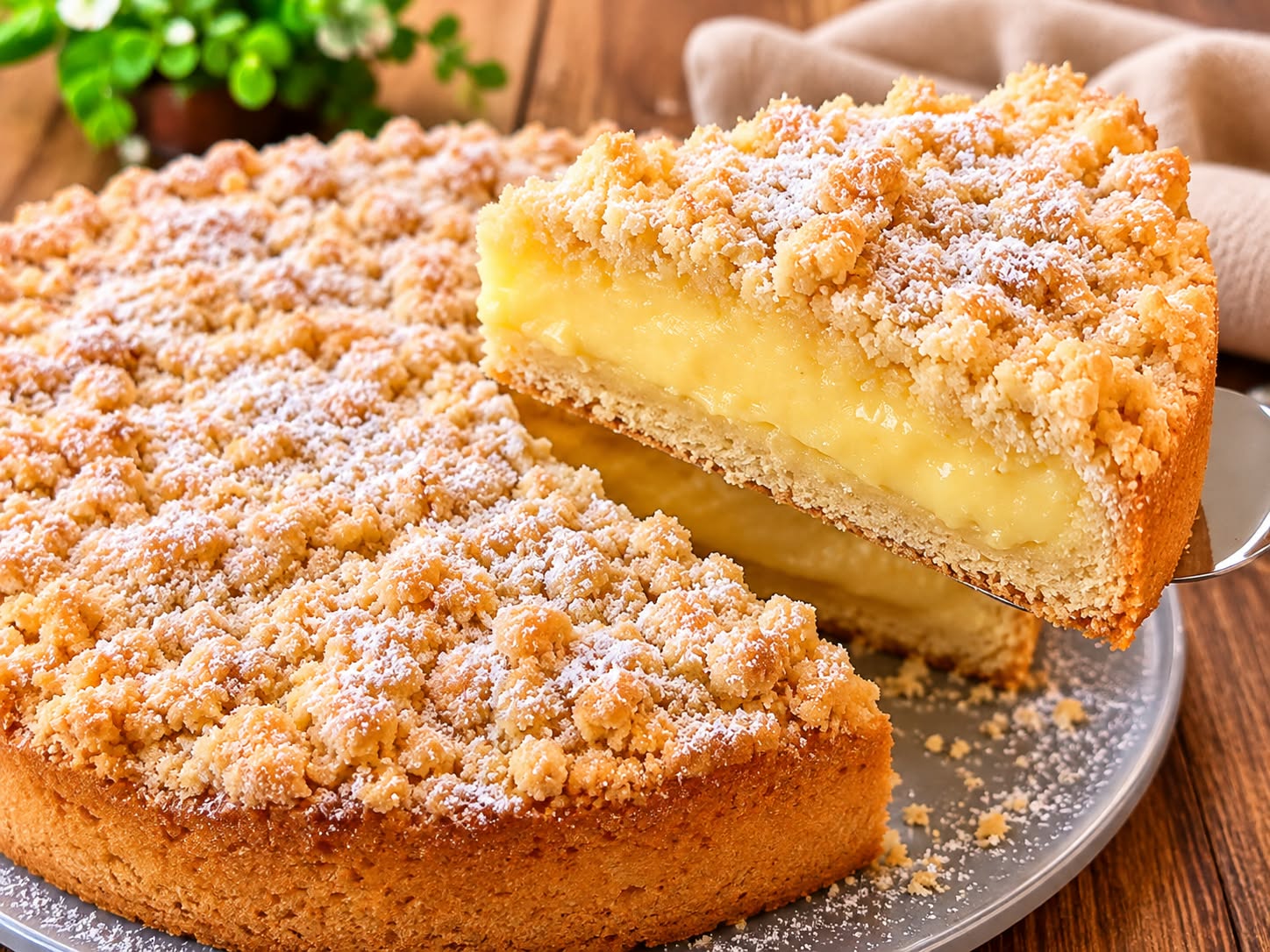
Custard Streusel Cake is a delicious, comforting dessert that combines a crisp, buttery crumble crust with a thick, velvety vanilla custard filling and a golden streusel topping.
Inspired by the Italian Sbriciolata alla Crema and related German custard streusel cakes, this dessert offers a wonderful contrast between crunchy pastry and smooth, creamy filling.
The cake is prepared using two main components: a homemade vanilla custard and a rich, crumbly dough.
The custard is made with whole milk, egg yolks, sugar, flour or cornstarch, and vanilla. It is gently cooked until thick, then cooled before being added to the pastry.
The crumble dough is made with flour, cold butter, sugar, eggs, baking powder, and salt. Rather than being kneaded into a smooth dough, the ingredients are combined into irregular crumbs and small clusters.
A little more than half of the crumble mixture is pressed into the bottom and sides of a springform pan to create a sturdy base.
The cooled custard is then spread evenly over the crust, and the remaining crumble is scattered across the surface.
During baking, the pastry becomes golden and lightly crisp while the vanilla custard remains soft and creamy.
Once cooled, the cake is dusted with powdered sugar for a simple, elegant finish.
This dessert is particularly appealing because it requires no elaborate frosting, piping, or decoration.
Its rustic appearance, delicate vanilla aroma, and contrasting textures make it suitable for afternoon tea, family gatherings, celebrations, and weekend baking.
The finished cake can be served chilled or slightly cool, allowing the custard to hold its shape while maintaining its creamy consistency.
2. Origin and Cultural Significance
Custard Streusel Cake brings together pastry traditions found in Italian and German baking.
Although the versions differ in ingredients and preparation, both traditions celebrate buttery pastry combined with creamy fillings.
Italian Sbriciolata alla Crema
In Italy, sbriciolata refers to a crumbly cake or tart.
The name comes from the Italian word associated with crumbling.
Instead of preparing a smooth pastry crust, the dough is left in small crumbs and clusters.
These crumbs form both the base and the topping.
The Role of Crema Pasticcera
Italian crema pasticcera, or pastry cream, is a classic custard used in cakes, tarts, pastries, and other desserts.
It is typically prepared using milk, egg yolks, sugar, a thickening ingredient, and flavorings such as vanilla or lemon.
Its smooth consistency makes it ideal for filling crumbly pastry cakes.
German Streuselkuchen
In Germany, Streuselkuchen is a traditional crumb-topped cake.
The word Streusel refers to the crumbly topping, commonly made with flour, butter, and sugar.
German variations may include yeast dough, fruit, custard, or pudding-style fillings.
Pudding-Streuselkuchen
German Pudding-Streuselkuchen typically features a creamy pudding or custard filling beneath a streusel topping.
It shares the appealing contrast between creamy and crumbly textures found in this recipe.
A Modern Home-Baking Favorite
Custard crumble cakes remain popular because they use familiar ingredients and require relatively simple equipment.
They are especially suitable for home bakers who enjoy rustic pastries with rich fillings.
A Dessert for Sharing
The cake is usually prepared in a round baking pan and sliced into wedges.
Its generous custard filling and buttery crumble make it ideal for sharing with family and friends.
3. Ingredients
This recipe makes one 9-inch (approximately 23 cm) round cake, yielding about 10–12 slices. An 8-inch pan will produce a thicker cake and may require a longer baking time.
A. Vanilla Custard Filling
| Ingredient | Quantity |
|---|---|
| Whole milk | 2 cups (500 ml) |
| Large egg yolks | 3 |
| Granulated sugar | ½ cup (100 g) |
| All-purpose flour or cornstarch | 50 g |
| Vanilla bean | 1, split |
| Or pure vanilla extract | 2 teaspoons |
| Fresh lemon peel | 1 strip, optional |
Note: Use 50 g by weight for the custard thickener. The volume of 50 g differs substantially between flour and cornstarch.
B. Streusel Crust and Topping
| Ingredient | Quantity |
|---|---|
| All-purpose flour | 3½ cups (420 g) |
| Cold unsalted butter, cubed | 7 oz (200 g) |
| Granulated sugar | ¾ cup (150 g) |
| Medium eggs | 2 |
| Baking powder | 1 teaspoon |
| Salt | 1 pinch |
C. Decoration
| Ingredient | Quantity |
|---|---|
| Powdered sugar | As needed for dusting |
D. Equipment
- 8-inch or 9-inch springform cake pan
- Medium saucepan
- Large mixing bowl
- Medium mixing bowl
- Whisk
- Rubber spatula
- Fine-mesh sieve
- Measuring cups and spoons
- Kitchen scale
- Parchment paper
- Plastic wrap or reusable food-safe covering
- Wire cooling rack
- Offset spatula
- Cake knife
- Oven
4. Optional Additions
The classic combination of vanilla custard and buttery crumble is delicious on its own, but several variations can add different flavors and textures.
Lemon Zest: Add finely grated lemon zest to the custard for a refreshing citrus note.
Orange Zest: Use orange zest for a warmer, sweeter aroma.
Vanilla Bean Seeds: Use fresh vanilla seeds for a more pronounced vanilla flavor.
Cinnamon: Add a small pinch to the crumble mixture.
Almond Extract: Add a few drops to the custard.
Fresh Raspberries: Scatter a small amount over the custard before adding the topping.
Blueberries: Add blueberries for a fruity variation.
Strawberries: Use chopped strawberries, drained of excess moisture.
Chocolate Chips: Sprinkle a small quantity over the custard.
Dark Chocolate: Add finely chopped dark chocolate for a chocolate-custard variation.
Toasted Almonds: Mix a small amount into the topping.
Hazelnuts: Add finely chopped toasted hazelnuts for crunch.
Powdered Sugar: Dust generously before serving.
Fruit Compote: Serve a small spoonful alongside each slice.
Whipped Cream: Add a modest dollop for an extra-creamy dessert.
For the most traditional custard-focused result, keep additions minimal so the vanilla filling remains the dominant flavor.
5. Tips for Success
Use Cold Butter
Cold butter is essential for creating a crumbly pastry texture.
Avoid Overworking the Dough
Mix the ingredients only until irregular crumbs and clusters form.
Do Not Knead into a Smooth Ball
A smooth dough will produce a different texture from the intended streusel crust.
Use a Kitchen Scale
Accurate measurements help maintain the correct balance between flour, butter, sugar, and eggs.
Heat the Milk Gently
The milk should be hot and beginning to simmer, but it should not boil vigorously.
Whisk the Custard Continuously
Constant whisking helps prevent lumps and scorching.
Temper the Egg Yolks
Adding the hot milk gradually prevents the egg yolks from cooking too quickly.
Cook the Custard Until Thick
The filling should be thick enough to hold its shape once cooled.
Cool the Custard Properly
Transfer it to a shallow bowl and cover the surface directly to prevent a skin from forming.
For food safety, cool it promptly and refrigerate until needed rather than leaving it at room temperature for an extended period.
Chill the Crumble Mixture
Refrigerating the dough for approximately 30 minutes helps maintain its crumbly texture.
Build a Sturdy Base
Press the bottom crust firmly enough to support the custard.
Create a Small Pastry Border
Press the dough approximately 1 inch up the sides to help contain the filling.
Use Completely Cooled Custard
Hot custard may soften the butter in the crumble dough.
Scatter the Topping Loosely
Avoid pressing the upper crumbs into the custard.
Watch the Baking Color
The topping should become golden brown without burning.
Cool Before Slicing
The custard needs time to firm up.
Refrigerate for Cleaner Slices
Chilling after cooling helps produce neat wedges.
6. Step-by-Step Instructions
Part A: Preparing the Ingredients
Step 1: Gather all ingredients and equipment.
Step 2: Measure 500 ml whole milk.
Step 3: Prepare three large egg yolks.
Step 4: Measure 100 g granulated sugar for the custard.
Step 5: Measure 50 g flour or cornstarch.
Step 6: Prepare the vanilla bean or vanilla extract.
Step 7: Prepare the optional lemon peel.
Step 8: Measure 420 g flour for the crumble.
Step 9: Measure 200 g cold unsalted butter.
Step 10: Measure 150 g sugar for the crumble.
Step 11: Prepare two medium eggs.
Step 12: Measure the baking powder and salt.
Part B: Preparing the Vanilla Milk
Step 13: Place a medium saucepan on the stove.
Step 14: Pour in the whole milk.
Step 15: If using a vanilla bean, split it lengthwise.
Step 16: Scrape the seeds into the milk.
Step 17: Add the vanilla pod.
Step 18: Add the optional strip of lemon peel.
Step 19: Place the saucepan over medium heat.
Step 20: Warm the milk gradually.
Step 21: Stir occasionally.
Step 22: Continue until small bubbles appear around the edges.
Step 23: Remove the saucepan from the heat before vigorous boiling.
Part C: Preparing the Egg Yolk Mixture
Step 24: Place the egg yolks in a mixing bowl.
Step 25: Add the granulated sugar.
Step 26: Whisk until smooth.
Step 27: Continue until the mixture becomes slightly lighter in color.
Step 28: Add the flour or cornstarch.
Step 29: Whisk until evenly incorporated.
Step 30: Break apart any lumps.
Step 31: Check that the mixture is smooth.
Part D: Tempering the Custard
Step 32: Remove the vanilla pod and lemon peel from the hot milk.
Step 33: Slowly pour a small amount of warm milk into the egg mixture.
Step 34: Whisk continuously.
Step 35: Add another small amount of milk.
Step 36: Continue whisking.
Step 37: Gradually incorporate the remaining milk.
Step 38: Ensure the mixture is smooth.
Part E: Cooking the Custard
Step 39: Pour the mixture back into the saucepan.
Step 40: Place it over low to medium-low heat.
Step 41: Begin stirring immediately.
Step 42: Use a whisk or spatula to reach the bottom of the pan.
Step 43: Continue stirring as the mixture warms.
Step 44: Watch for the first signs of thickening.
Step 45: Continue cooking for approximately 5–7 minutes, depending on the heat.
Step 46: Stir continuously to prevent lumps.
Step 47: Allow the custard to become thick and smooth.
Step 48: Once it begins bubbling, cook briefly while stirring to ensure the starch is properly cooked.
Step 49: Remove from the heat.
Step 50: If using vanilla extract instead of a bean, stir it in now.
Part F: Cooling the Custard
Step 51: Transfer the custard to a clean, shallow bowl.
Step 52: Spread it into an even layer.
Step 53: Press food-safe plastic wrap directly against the surface.
Step 54: Ensure the surface is covered to prevent a skin.
Step 55: Allow the steam to subside briefly.
Step 56: Refrigerate promptly until the custard is cool.
Step 57: Keep refrigerated while preparing the crumble.
Part G: Preparing the Crumble Ingredients
Step 58: Place a large mixing bowl on the counter.
Step 59: Add 420 g all-purpose flour.
Step 60: Add 150 g granulated sugar.
Step 61: Add 1 teaspoon baking powder.
Step 62: Add a pinch of salt.
Step 63: Mix the dry ingredients.
Step 64: Cut the cold butter into small cubes.
Part H: Incorporating the Butter
Step 65: Add the butter cubes to the flour mixture.
Step 66: Toss gently to coat the butter.
Step 67: Begin rubbing the butter into the flour with your fingertips.
Step 68: Work quickly to keep the butter cold.
Step 69: Continue until the mixture resembles coarse sand.
Step 70: Leave some small butter pieces visible.
Step 71: Avoid allowing the mixture to become greasy.
Part I: Adding the Eggs
Step 72: Crack the first egg into the crumble mixture.
Step 73: Add the second egg.
Step 74: Mix gently with your fingers or a fork.
Step 75: Begin forming small clumps.
Step 76: Continue until the eggs are incorporated.
Step 77: Leave the mixture crumbly.
Step 78: Avoid kneading it into a smooth dough.
Step 79: Check that the mixture contains crumbs of different sizes.
Part J: Chilling the Crumble
Step 80: Cover the mixing bowl.
Step 81: Place it in the refrigerator.
Step 82: Chill for approximately 30 minutes.
Step 83: Allow the butter to firm up.
Step 84: Keep the crumble refrigerated until assembly.
Part K: Preparing the Oven
Step 85: Preheat the oven to 350°F (175°C).
Step 86: Position a rack near the center.
Step 87: Allow the oven to reach the correct temperature.
Part L: Preparing the Springform Pan
Step 88: Select an 8-inch or 9-inch springform pan.
Step 89: Lightly grease the bottom.
Step 90: Grease the sides.
Step 91: Cut parchment paper to fit the bottom.
Step 92: Place the parchment in the pan.
Step 93: Check that the springform ring is securely fastened.
Part M: Dividing the Crumble
Step 94: Remove the chilled crumble from the refrigerator.
Step 95: Gently loosen any large clumps.
Step 96: Separate a little more than half for the base.
Step 97: Reserve the remaining mixture for the topping.
Step 98: Keep the reserved topping cool.
Part N: Building the Bottom Crust
Step 99: Transfer the larger portion of crumble into the prepared pan.
Step 100: Spread it across the bottom.
Step 101: Press gently with your fingers.
Step 102: Continue until the bottom is evenly covered.
Step 103: Press the crumbs firmly enough to create a stable base.
Step 104: Avoid compacting the dough excessively.
Part O: Creating the Side Crust
Step 105: Push some of the crumble mixture toward the edges.
Step 106: Press it approximately 1 inch up the sides.
Step 107: Continue around the entire pan.
Step 108: Make sure the border is reasonably even.
Step 109: Check that there are no large gaps.
Step 110: Smooth the base gently.
Part P: Preparing the Custard for Assembly
Step 111: Remove the cooled custard from the refrigerator.
Step 112: Remove the plastic wrap.
Step 113: Check the texture.
Step 114: Stir briefly if necessary to restore a smooth consistency.
Step 115: Avoid thinning the custard excessively.
Part Q: Filling the Cake
Step 116: Spoon the custard into the prepared crust.
Step 117: Begin in the center.
Step 118: Add the remaining custard.
Step 119: Spread gently toward the edges.
Step 120: Use an offset spatula to level the surface.
Step 121: Keep the filling inside the pastry border.
Step 122: Check that the layer is even.
Part R: Adding the Streusel Topping
Step 123: Remove the reserved crumble mixture from the refrigerator.
Step 124: Break apart any oversized clumps.
Step 125: Sprinkle the crumbs over the custard.
Step 126: Begin around the edges.
Step 127: Continue toward the center.
Step 128: Distribute the crumbs evenly.
Step 129: Leave some larger clusters for texture.
Step 130: Avoid pressing the topping into the custard.
Step 131: Check that the surface is evenly covered.
Part S: Baking the Cake
Step 132: Place the cake pan in the preheated oven.
Step 133: Bake at 350°F (175°C).
Step 134: Allow the pastry to begin setting.
Step 135: Avoid opening the oven unnecessarily during the early baking period.
Step 136: Check the surface after approximately 35 minutes.
Step 137: Look for a developing golden color.
Step 138: If the topping browns too quickly, cover loosely with aluminum foil.
Step 139: Continue baking.
Step 140: The total baking time should be approximately 45–55 minutes.
Step 141: Check that the streusel is golden brown.
Step 142: The pastry edges should appear set.
Step 143: Remove the cake from the oven when fully baked.
Part T: Initial Cooling
Step 144: Place the springform pan on a wire cooling rack.
Step 145: Allow the cake to cool undisturbed.
Step 146: Avoid removing the springform ring immediately.
Step 147: Let the filling begin to stabilize.
Step 148: Continue cooling in the pan.
Part U: Setting the Custard
Step 149: Allow the cake to cool completely.
Step 150: Plan for at least approximately 2 hours of cooling, depending on room temperature.
Step 151: Once no longer hot, refrigerate the cake if needed for a firmer filling.
Step 152: Keep the cake level.
Step 153: Avoid slicing while the custard is warm and soft.
Part V: Removing the Cake from the Pan
Step 154: Check that the cake has cooled and set.
Step 155: Carefully release the springform ring.
Step 156: Lift the ring away.
Step 157: Check that the sides remain intact.
Step 158: Transfer the cake to a serving plate if desired.
Part W: Decorating with Powdered Sugar
Step 159: Place a small amount of powdered sugar in a fine-mesh sieve.
Step 160: Hold the sieve above the cake.
Step 161: Dust the surface gently.
Step 162: Distribute the powdered sugar evenly.
Step 163: Avoid adding excessive sugar.
Part X: Slicing and Serving
Step 164: Prepare a sharp cake knife.
Step 165: Cut the cake into even wedges.
Step 166: Wipe the knife between cuts.
Step 167: Lift each slice carefully.
Step 168: Transfer to dessert plates.
Step 169: Serve chilled or slightly cool.
Step 170: Enjoy the contrast between crisp streusel and creamy vanilla custard.
7. Description
Custard Streusel Cake is a rich, rustic dessert featuring three distinctive layers.
The bottom consists of a buttery, crumbly pastry crust.
The center is filled with thick, smooth vanilla custard.
The top is covered with golden streusel crumbs that create a lightly crisp finish.
The crust has a delicate, shortbread-like texture.
The custard is creamy, velvety, and gently sweet.
Vanilla provides a warm, aromatic flavor.
If lemon peel is used, it adds a subtle citrus note.
The topping contains irregular crumbs and clusters, giving the cake its characteristic rustic appearance.
When sliced, the cake reveals a thick pale-yellow custard layer between two golden pastry sections.
The contrast between the crunchy topping and soft filling is the defining feature of the dessert.
A light dusting of powdered sugar adds a simple finishing touch.
The overall flavor is buttery, creamy, sweet, and aromatic.
The cake is especially enjoyable with coffee or tea.
8. Nutritional Information
Approximate nutritional values per serving, assuming the cake is divided into 12 slices:
| Nutrient | Estimated Amount |
|---|---|
| Calories | 420–500 kcal |
| Protein | 7–9 g |
| Carbohydrates | 50–60 g |
| Total Fat | 20–25 g |
| Saturated Fat | 12–15 g |
| Fiber | 1–2 g |
| Sugar | 20–25 g |
| Sodium | Variable |
| Calcium | Present |
| Iron | Present |
| Vitamin A | Present |
| Vitamin B12 | Present |
These are estimates based on the listed ingredients. Exact values depend on ingredient brands, whether flour or cornstarch is used, portion size, and optional additions.
9. Recipe Details
| Category | Details |
|---|---|
| Recipe Name | Custard Streusel Cake |
| Italian Name | Sbriciolata alla Crema |
| Related German Dessert | Pudding-Streuselkuchen |
| Cuisine | Italian-Inspired / German-Inspired |
| Course | Dessert |
| Preparation Time | Approximately 30–40 Minutes |
| Crumble Chilling Time | 30 Minutes |
| Baking Time | 45–55 Minutes |
| Cooling and Setting Time | At Least 2 Hours |
| Total Time | Approximately 4–5 Hours |
| Yield | 1 Round Cake |
| Servings | 10–12 Slices |
| Difficulty | Intermediate |
| Pan Size | 8–9 Inches |
| Baking Temperature | 350°F (175°C) |
| Main Filling | Vanilla Pastry Cream |
| Crust | Buttery Crumble Dough |
| Topping | Golden Streusel |
| Main Flavor | Vanilla and Butter |
| Texture | Crisp, Crumbly, Creamy |
| Decoration | Powdered Sugar |
| Best For | Afternoon Tea, Family Gatherings, Celebrations |
| Storage | Refrigerated |
| Potential Allergens | Wheat, Eggs, Milk |
10. Conclusion
Custard Streusel Cake is a delicious dessert that combines the rich flavor of buttery pastry with the smooth texture of homemade vanilla custard.
Inspired by Italian Sbriciolata alla Crema and related German streusel cakes, it celebrates the contrast between crumbly pastry and creamy filling.
The recipe begins with a vanilla custard prepared from milk, egg yolks, sugar, flour or cornstarch, and vanilla.
The custard is cooked until thick and cooled before assembly.
A separate crumble dough is made using flour, butter, sugar, eggs, baking powder, and salt.
Part of the dough forms the bottom crust and side border.
The custard is spread over the base, and the remaining crumbs are scattered over the top.
During baking, the pastry develops a golden-brown color while the filling remains creamy.
After cooling and setting, the cake is finished with powdered sugar.
The result is a rustic yet elegant dessert suitable for many occasions.
Whether served with coffee, tea, or enjoyed on its own, Custard Streusel Cake offers a satisfying combination of sweetness, richness, and contrasting textures.
11. Serving and Storage Recommendations
Serve Chilled or Slightly Cool: The custard holds its shape best after cooling and setting.
Powdered Sugar: Dust shortly before serving.
Coffee: Pair with espresso, cappuccino, or freshly brewed coffee.
Tea: Serve with black tea or herbal tea.
Fresh Berries: Add a few raspberries or strawberries alongside each slice.
Fruit Compote: Serve with a small spoonful of berry compote.
Whipped Cream: Add a modest dollop if desired.
Clean Slicing: Use a sharp knife and wipe between cuts.
Refrigeration: Store the cake in an airtight container in the refrigerator.
Storage Duration: For best quality, enjoy within approximately 3–4 days.
Avoid Extended Room-Temperature Storage: The custard contains milk and eggs and requires refrigeration.
Freezing: Freezing is possible, but the custard may become watery or grainy after thawing.
Best Freezing Practice: Freeze individual slices tightly wrapped if necessary.
Thawing: Thaw frozen slices in the refrigerator.
Texture: The streusel may soften during refrigeration.
Food Safety: Refrigerate the cake promptly after cooling and do not leave it at room temperature for more than 2 hours.
12. Embracing Healthful Indulgence
Custard Streusel Cake is a rich homemade dessert made with familiar baking ingredients.
Its creamy filling and buttery crumble provide a satisfying combination of flavor and texture.
Whole Milk
Whole milk contributes protein, calcium, and other nutrients.
It also creates the smooth texture of the custard.
Egg Yolks
Egg yolks provide nutrients such as choline and vitamin B12.
They also contribute richness and help thicken the custard.
Flour
Flour provides carbohydrates and structure.
It helps form the crumbly pastry crust.
Butter
Butter is responsible for much of the cake’s rich flavor and tender pastry texture.
Because the recipe contains a substantial amount of butter, it is relatively high in saturated fat.
Vanilla
Vanilla contributes aroma and flavor without requiring large quantities.
Lemon Peel
Optional lemon peel adds citrus fragrance and brightness.
Sugar
Sugar sweetens both the custard and the crumble.
It also contributes to the texture and browning of the pastry.
Portion Awareness
Custard Streusel Cake is rich and satisfying.
Serving moderate slices allows the dessert to be enjoyed without requiring a large portion.
Pairing with Fresh Fruit
Fresh berries can add color, fiber, and natural fruit flavor.
They also provide a refreshing contrast to the creamy custard.
Homemade Baking
Preparing the cake at home allows control over ingredients and portion sizes.
It also provides an opportunity to practice classic custard and crumble techniques.
Enjoying Traditional Desserts
Desserts can be enjoyed as part of a varied eating pattern.
Custard Streusel Cake is especially suitable for occasional celebrations, family gatherings, and afternoon treats.
With its golden buttery crumbs, thick vanilla filling, and rustic appearance, this cake offers a comforting and memorable homemade dessert experience.