
1. Introduction
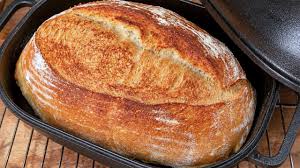
This Homemade Sourdough Bread features a beautifully golden, crackling crust and a soft, flavorful interior. Made with an active sourdough starter, bread flour, and a touch of whole wheat, it develops its distinctive flavor through slow fermentation. Baked in a cast-iron bread oven, this rustic loaf is perfect for sandwiches, toast, or serving alongside homemade meals.
2. Origin and Cultural Significance
Sourdough bread is one of the oldest forms of naturally leavened bread, made using wild yeast and beneficial bacteria instead of commercial yeast.
Its distinctive tangy flavor develops during fermentation.
Rustic loaves such as the batard, an elongated French-style bread, are popular in artisan baking.
Modern cast-iron bread ovens help recreate the steamy environment of traditional bread ovens, producing excellent crust development and oven spring.
3. Ingredients
For the Sourdough Bread
- 335 g warm water, approximately 80–90°F (27–32°C)
- 100 g active, mature sourdough starter
- 450 g unbleached bread flour
- 50 g whole-wheat flour
- 10–12 g kosher salt
- Rice flour, for dusting the proofing basket
- A little olive oil, for lightly greasing the bread oven base
Salt note: Le Creuset’s published Everyday Sourdough Bread recipe lists 20 g of kosher salt. This is considerably higher than the usual bread-making range of approximately 1.8–2% of flour weight. For a more balanced everyday loaf, this version uses 10–12 g. Le Creuset®+1
4. Optional Additions
- Sesame seeds: Sprinkle over the dough before baking.
- Fresh rosemary: Add finely chopped rosemary for an aromatic loaf.
- Roasted garlic: Fold roasted garlic into the dough for extra flavor.
- Sunflower seeds: Incorporate a small handful for added texture.
- Extra whole-wheat flour: Replace a little more bread flour for a heartier taste, adjusting hydration if necessary.
5. Tips for Success
- Use active starter: The starter should be bubbly and noticeably expanded after feeding.
- Measure by weight: A digital kitchen scale improves accuracy.
- Watch the dough, not just the clock: Fermentation depends on temperature and starter activity.
- Develop gluten gradually: Stretch-and-folds strengthen the dough without intensive kneading.
- Create surface tension: Proper shaping helps the loaf rise upward.
- Score confidently: A sharp bread lame allows controlled expansion.
- Cool completely: Cutting too early can produce a gummy interior.
The Le Creuset Signature Bread Oven is designed with a domed lid that retains steam and a low-profile base that promotes crust browning. It is rated for oven temperatures up to 500°F (260°C). Le Creuset®
6. Step-by-Step Instructions
Step 1: Mix the Dough
In a large mixing bowl, combine the warm water and active sourdough starter.
Stir until the starter is dispersed throughout the water.
Add the bread flour and whole-wheat flour.
Mix until a shaggy dough forms and no dry flour remains.
Cover and rest for approximately 30 minutes.
Step 2: Add the Salt
Sprinkle the salt evenly over the dough.
Lightly wet your hands and gently squeeze and fold the dough until the salt is fully incorporated.
Cover the bowl again.
Step 3: Begin Bulk Fermentation
Leave the dough in a warm location.
During the first 2–3 hours, perform four sets of stretch-and-folds, spaced approximately 30–60 minutes apart.
For each set:
- Lift one side of the dough.
- Stretch it gently upward.
- Fold it toward the center.
- Rotate the bowl and repeat on all four sides.
Step 4: Complete Bulk Fermentation
After the final fold, cover the dough and allow it to continue fermenting.
The total bulk fermentation may take approximately 4–8 hours, depending on room temperature and starter strength.
The dough is ready when it has expanded by approximately 50%, feels airy, and shows visible bubbles.
Step 5: Shape the Loaf
Transfer the dough onto a lightly floured work surface.
Gently stretch it into a rectangle.
Fold the sides inward, then roll the dough into a compact oval shape.
Create gentle surface tension without pressing out too much air.
For the round Signature Bread Oven, a round boule is another suitable shape.
Step 6: Cold Proof
Dust a proofing basket generously with rice flour.
Place the shaped dough into the basket, seam-side up.
Cover and refrigerate for 12–18 hours.
This slow fermentation develops flavor and helps the dough retain its shape.
Step 7: Preheat the Oven
Preheat your conventional oven to 500°F (260°C) for approximately 30–45 minutes.
For this version, keep the bread oven base at room temperature, following the transfer method in Le Creuset’s Everyday Sourdough Bread recipe.
Lightly brush the base with olive oil.
Step 8: Score and Transfer
Remove the dough from the refrigerator.
Carefully invert it onto the prepared bread oven base.
Lightly dust the surface with flour if desired.
Using a bread lame or sharp razor blade, score the loaf approximately ¼–½ inch deep.
For an oval loaf, make one confident lengthwise slash.
Step 9: Bake Covered
Place the domed lid over the bread.
Transfer the covered bread oven into the preheated oven.
Immediately reduce the temperature to 450°F (230°C).
Bake covered for approximately 30 minutes.
The enclosed steam helps the bread expand before the crust fully sets.
Step 10: Bake Uncovered
Carefully remove the lid using oven mitts.
Continue baking uncovered for another 20–25 minutes.
The loaf is ready when the crust becomes deep golden brown and well developed.
Step 11: Cool Completely
Transfer the baked bread to a wire cooling rack.
Allow it to cool for at least 1–2 hours before slicing.
This resting period helps the interior finish setting.
7. Description
This homemade sourdough loaf features a crisp, deeply browned crust with a tender, slightly chewy interior.
The slow fermentation creates a pleasantly tangy flavor, while the combination of bread flour and whole-wheat flour provides structure and subtle nuttiness.
Its rustic shape and attractive scoring make it a beautiful addition to any homemade meal.
8. Nutritional Information
Approximate nutritional values per slice, assuming 12 slices:
| Nutrient | Estimated Amount |
|---|---|
| Calories | 160–185 kcal |
| Protein | 5–6 g |
| Carbohydrates | 32–36 g |
| Total Fat | 1 g |
| Fiber | 1–2 g |
| Sugar | Less than 1 g |
Values depend on flour brands, slice size, and the amount of oil used.
9. Recipe Details
| Detail | Information |
|---|---|
| Recipe Name | Everyday Homemade Sourdough Bread |
| Preparation Time | 30 minutes active |
| Bulk Fermentation | Approximately 4–8 hours |
| Cold Proofing | 12–18 hours |
| Baking Time | 50–55 minutes |
| Cooling Time | 1–2 hours |
| Total Time | Approximately 19–30 hours |
| Yield | 1 loaf |
| Difficulty | Intermediate |
| Cuisine | European-Inspired Artisan Bread |
| Course | Bread |
| Cooking Method | Cast-Iron Oven Baking |
10. Conclusion
Homemade Sourdough Bread is a rewarding baking project that transforms simple ingredients into a flavorful artisan loaf.
The combination of natural fermentation, careful shaping, and covered baking creates a beautiful crust and tender interior.
Although sourdough requires patience, most of the preparation time involves resting and fermentation rather than active work.
11. Recommendation
For the best results, start with a strong, active sourdough starter and pay close attention to the dough’s development during fermentation.
Avoid relying exclusively on fixed rising times, since sourdough activity changes with temperature.
Use the bread oven according to its manufacturer’s instructions and handle the hot cast iron carefully.
Allow the loaf to cool completely before cutting.
Store the bread in a bread bag or wrapped in a clean towel for 2–3 days at room temperature. For longer storage, slice and freeze it.
12. Embracing Healthful Indulgence
Homemade sourdough bread is a satisfying addition to a balanced diet.
The whole-wheat flour contributes fiber and nutrients, while natural fermentation develops the bread’s characteristic flavor.
Because this recipe contains no added sugar and very little fat, it can serve as a versatile base for nutritious meals.
Enjoy slices with avocado, eggs, hummus, vegetables, or other wholesome toppings for a delicious homemade breakfast or lunch.