
Prep Time: 35 minutes Cook Time: 60–75 minutes Total Time: Approximately 1 hour 50 minutes Servings: 6–8 Difficulty: Intermediate Category: Main Course, Comfort Food, European-Inspired Cuisine, Family Dinner
1. Introduction
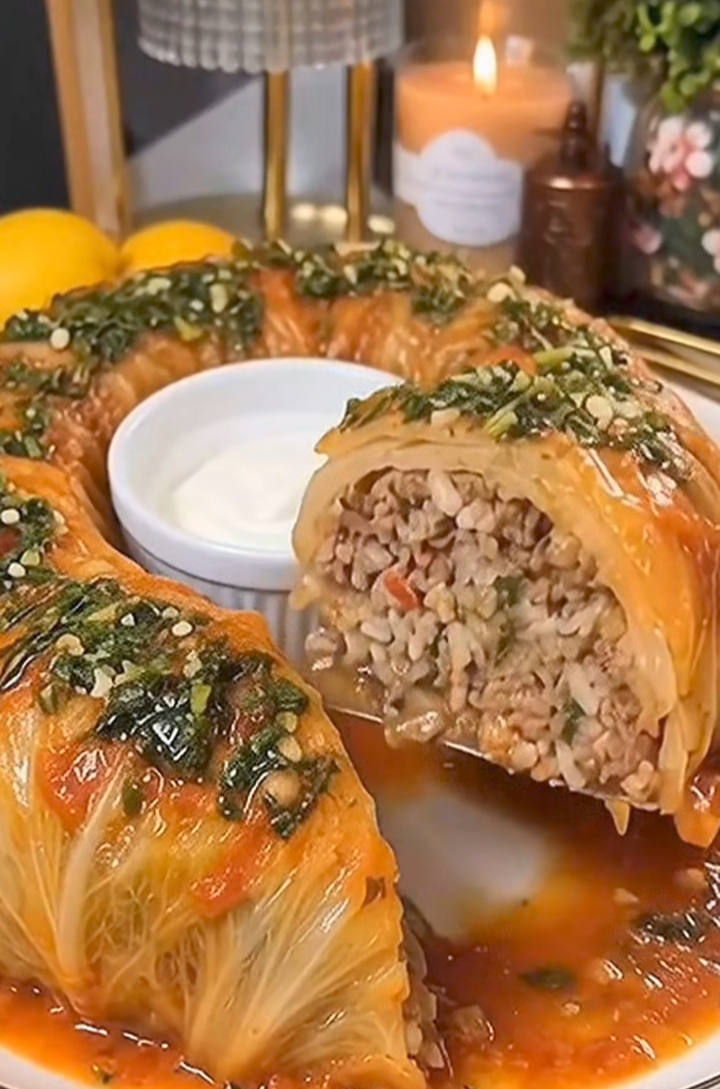
The Ultimate Stuffed Cabbage Bundt Ring is a creative and elegant twist on traditional stuffed cabbage rolls, combining the comforting flavors of seasoned ground beef, tender cabbage, fluffy rice, and rich tomato sauce in a beautiful ring-shaped presentation.
Instead of individually filling and rolling cabbage leaves, this recipe uses a Bundt pan to create an impressive centerpiece that can be easily sliced and served.
The preparation begins with softened cabbage leaves carefully arranged inside a greased Bundt pan to form a natural outer shell. Inside, a savory filling of ground beef, cooked white rice, sautéed onions, garlic, fresh parsley, and aromatic seasonings creates a hearty and flavorful center.
A rich tomato sauce made with tomato sauce, tomato paste, and beef broth is poured over the filling, allowing the ingredients to cook together and develop a delicious, comforting flavor.
During baking, the cabbage becomes tender while the seasoned meat filling retains its moisture and develops a satisfying texture.
Once cooked, the cabbage ring is carefully inverted onto a serving platter and finished with fragrant herb-infused olive oil.
A side of sour cream or Greek yogurt adds a cool, creamy contrast to the warm tomato sauce and savory filling.
Perfect for family gatherings, weekend dinners, holiday meals, or special occasions, this Stuffed Cabbage Bundt Ring transforms a traditional comfort-food favorite into an impressive homemade dish.
2. Origin and Cultural Significance
Stuffed cabbage rolls are a traditional dish found in numerous cuisines across Central Europe, Eastern Europe, the Middle East, and parts of the Mediterranean.
Although their exact historical origins are difficult to establish, stuffed cabbage preparations have become particularly associated with countries such as Poland, Hungary, Romania, Ukraine, and various Balkan nations.
In Poland, stuffed cabbage rolls are known as Gołąbki, traditionally prepared using cabbage leaves filled with ground meat and rice or other grains, then cooked in a flavorful tomato-based sauce.
In Hungary, a similar preparation is known as Töltött Káposzta, often featuring seasoned meat, rice, and fermented cabbage.
Romanian cuisine includes Sarmale, which are commonly prepared using fermented cabbage leaves and filled with a mixture of minced meat and rice.
Across these culinary traditions, cabbage has historically been valued because it is affordable, nutritious, widely available, and suitable for preservation.
Combining cabbage with meat and grains also creates a satisfying meal capable of feeding large families.
The traditional process involves carefully separating cabbage leaves, filling them individually, rolling them into small parcels, and cooking them slowly in sauce.
The Stuffed Cabbage Bundt Ring represents a contemporary presentation inspired by these traditional preparations.
Instead of forming individual cabbage rolls, the cabbage leaves are arranged inside a ring-shaped mold and filled with the seasoned meat mixture.
This modern technique preserves the familiar flavors while creating a visually striking dish that can be sliced like a savory cake.
Although the Bundt-ring presentation is a modern adaptation rather than a traditional regional preparation, it celebrates the same culinary values of comfort, family cooking, resourcefulness, and shared meals.
Today, creative cabbage roll variations are popular among home cooks who want to combine traditional flavors with attractive presentation and convenient serving techniques.
3. Ingredients and Quantities
A. For the Cabbage Shell
| Ingredient | Quantity |
|---|---|
| Large green cabbage | 1 whole |
| Olive oil or cooking spray | 1 tablespoon, for greasing the Bundt pan |
Why Use Green Cabbage?
Green cabbage has flexible leaves that soften during blanching and become tender during baking.
Its mild flavor complements the savory meat filling and tomato sauce.
Why Blanch the Cabbage?
Blanching softens the leaves, making them flexible enough to line the Bundt pan without tearing.
It also helps the cabbage cook evenly during baking.
B. For the Savory Beef and Rice Filling
| Ingredient | Quantity |
|---|---|
| Ground beef | 1.5 lbs (680 g) |
| Cooked white rice, slightly cooled | 1½ cups |
| Small yellow onion, finely diced | 1 |
| Garlic cloves, minced | 3 |
| Large egg | 1 |
| Fresh parsley, chopped | 2 tablespoons |
| Paprika | 1 teaspoon |
| Salt | 1 teaspoon |
| Ground black pepper | ½ teaspoon |
Why Use Ground Beef?
Ground beef provides a rich, savory flavor and creates a hearty filling that complements the mild sweetness of cooked cabbage.
Why Add Cooked Rice?
Rice provides structure and helps distribute the meat mixture evenly throughout the cabbage ring.
It also absorbs some of the flavorful juices released during cooking.
Why Use an Egg?
The egg acts as a binding ingredient, helping the ground beef and rice mixture hold together when the finished ring is sliced.
Why Add Fresh Parsley?
Fresh parsley contributes a clean herbal flavor that balances the richness of the meat.
Why Use Paprika?
Paprika provides a warm, slightly sweet flavor and enhances the color of the filling.
C. For the Simmering Tomato Sauce
| Ingredient | Quantity |
|---|---|
| Tomato sauce | 1 can (15 oz / 425 g) |
| Beef broth or chicken broth | ½ cup (120 ml) |
| Tomato paste | 1 tablespoon |
| Salt | To taste, if necessary |
| Black pepper | To taste, if necessary |
Why Use Tomato Sauce?
Tomato sauce creates the flavorful liquid that surrounds the cabbage ring and keeps the filling moist during baking.
Why Add Beef Broth?
Beef broth introduces additional savory depth and helps thin the tomato sauce to the appropriate consistency.
Why Use Tomato Paste?
Tomato paste intensifies the tomato flavor and gives the sauce a richer color and consistency.
D. For the Herb Oil Garnish
| Ingredient | Quantity |
|---|---|
| Extra-virgin olive oil | 3 tablespoons |
| Fresh parsley, finely chopped | 1 tablespoon |
| Fresh dill, finely chopped | 1 teaspoon |
| Garlic, finely minced | 1 small clove |
Why Use Herb-Infused Olive Oil?
The herb oil provides a fragrant finishing touch and adds freshness to the rich meat filling.
Parsley contributes herbal brightness, dill provides a distinctive aromatic note, and garlic adds savory depth.
E. For Serving
| Ingredient | Quantity |
|---|---|
| Sour cream | ½ cup |
| Plain Greek yogurt (alternative) | ½ cup |
| Fresh dill or parsley | For garnish |
| Freshly cracked black pepper | To taste |
Why Serve with Sour Cream?
Sour cream provides a cool, slightly tangy contrast to the warm tomato sauce and savory meat filling.
Greek yogurt offers a lighter alternative with a similar creamy texture.
F. Recommended Equipment
- 10–12 cup Bundt pan
- Large pot for blanching cabbage
- Large mixing bowl
- Large saucepan
- Sharp chef’s knife
- Cutting board
- Colander
- Aluminum foil
- Baking sheet
- Measuring cups and spoons
- Kitchen tongs
- Meat thermometer
- Large serving platter
4. Optional Additions
This Stuffed Cabbage Bundt Ring can be customized with additional ingredients to create different flavor profiles.
Ground Pork: Replace half of the ground beef with ground pork for a richer and more tender filling.
Ground Turkey: Substitute ground beef with ground turkey for a lighter variation.
Carrots: Add ½ cup of finely grated carrots to the filling for natural sweetness and additional vegetables.
Bell Peppers: Incorporate ½ cup of finely diced red bell pepper for color and sweetness.
Mushrooms: Add ½ cup of finely chopped sautéed mushrooms for an earthy, savory flavor.
Worcestershire Sauce: Add 1 tablespoon to the meat mixture for additional savory complexity.
Italian Seasoning: Incorporate 1 teaspoon for a Mediterranean-inspired flavor.
Dried Oregano: Add ½ teaspoon to the tomato sauce for additional herbal depth.
Red Pepper Flakes: Add ¼ teaspoon for a subtle spicy finish.
Brown Sugar: Add ½ teaspoon to the tomato sauce if the tomatoes are particularly acidic.
Parmesan Cheese: Mix ¼ cup of freshly grated Parmesan into the filling for a richer flavor.
Mozzarella Cheese: Add a small amount of shredded mozzarella to the center of the meat mixture for a cheesy variation.
Fresh Thyme: Include a few fresh thyme leaves in the tomato sauce for additional aroma.
Lemon Juice: Add 1 teaspoon to the herb oil for a refreshing citrus finish.
Bay Leaf: Add one bay leaf to the tomato sauce while simmering, then remove before assembling.
5. Tips for Success
Choose a large cabbage. A large cabbage provides enough leaves to line the Bundt pan and completely cover the filling.
Soften the cabbage properly. Blanching makes the leaves flexible and prevents them from breaking during assembly.
Remove thick cabbage ribs. Trim or gently flatten the thick central ribs to make the leaves easier to arrange.
Avoid overcooking the cabbage during blanching. The leaves should be flexible but should not become excessively soft or fall apart.
Cool the rice before mixing. Slightly cooled rice prevents excessive heat from affecting the raw meat mixture.
Use ground beef with moderate fat content. An 85/15 ground beef blend provides good flavor and moisture without producing excessive grease.
Sauté the onions and garlic. Cooking them briefly before adding them to the filling develops a sweeter, more aromatic flavor.
Mix the filling gently. Overmixing ground beef can produce a dense, compact texture.
Do not overfill the Bundt pan. Leave a little room at the top so the cabbage leaves can fold over the filling.
Overlap the cabbage leaves. Overlapping creates a continuous shell and helps prevent the meat filling from escaping.
Press the filling evenly. Distribute the meat and rice mixture throughout the ring to ensure consistent cooking.
Use enough tomato sauce. The sauce helps maintain moisture and contributes flavor during baking.
Cover the Bundt pan tightly. Aluminum foil helps retain steam and prevents the exposed cabbage from drying out.
Use a baking sheet underneath. This catches any sauce that may bubble over during baking.
Check the internal temperature. The center of the ground beef filling must reach at least 160°F (71°C).
Allow the ring to rest before unmolding. Resting helps the filling settle and reduces the risk of the ring breaking apart.
Invert carefully. Use a large serving platter that completely covers the Bundt pan opening.
6. Step-by-Step Instructions
Part A: Preparing the Cabbage Shell
Step 1: Prepare the Cabbage
Remove any damaged or wilted outer leaves from the green cabbage.
Rinse the cabbage thoroughly under cold running water.
Place it on a clean cutting board.
Using a sharp knife, carefully remove the tough central core.
Make a deep circular cut around the core to help separate the leaves more easily.
Keep the cabbage intact as much as possible.
Step 2: Separate the Cabbage Leaves
Bring a large pot of water to a boil.
Carefully place the whole cabbage into the boiling water.
Allow it to cook for approximately 2–3 minutes.
As the outer leaves soften, use kitchen tongs to gently remove them one at a time.
Continue until you have approximately 12–16 large, flexible leaves.
The exact quantity depends on the size of the cabbage and the Bundt pan.
If the inner leaves remain too firm, return the cabbage to the boiling water for another 1–2 minutes.
Step 3: Cool and Drain the Leaves
Transfer the softened cabbage leaves into a large bowl of cold water to stop the cooking process.
Remove them from the water and place them in a colander.
Allow excess water to drain.
Arrange the leaves on a clean kitchen towel or paper towels.
Pat them dry carefully.
Removing excess moisture helps prevent the finished ring from becoming watery.
Step 4: Trim the Thick Ribs
Place each cabbage leaf on a cutting board.
Using a sharp knife, carefully shave down the thick central rib.
Do not cut through the entire leaf.
The objective is to make the leaves flexible enough to line the Bundt pan without tearing.
Set aside the prepared leaves.
Step 5: Prepare the Bundt Pan
Choose a standard 10–12 cup Bundt pan.
Lightly grease the entire interior using 1 tablespoon of olive oil or cooking spray.
Make sure the central tube, bottom, and sides are coated evenly.
This is important because the cabbage ring must release cleanly after baking.
Step 6: Arrange the Cabbage Leaves
Begin placing the prepared cabbage leaves inside the Bundt pan.
Arrange them around the central tube, allowing each leaf to overlap the previous one.
The leaves should cover the bottom and sides of the pan.
Allow the outer edges to extend beyond the rim.
These overlapping edges will later fold over the meat filling.
Continue arranging leaves until the entire interior is covered.
Reserve several additional leaves for closing the top of the ring.
Part B: Preparing the Savory Beef Filling
Step 7: Prepare the Onion and Garlic
Peel the yellow onion and dice it finely.
Peel and mince the three garlic cloves.
Place a small skillet over medium heat.
Add a teaspoon of olive oil if needed.
Add the diced onion and sauté for approximately 3–4 minutes until softened.
Add the minced garlic and cook for another 30 seconds.
Remove from the heat and allow the mixture to cool slightly.
Step 8: Combine the Ground Beef and Rice
Place the ground beef in a large mixing bowl.
Add the 1½ cups of cooked, slightly cooled white rice.
Use a wooden spoon or clean hands to combine them gently.
Break up any large clumps of rice.
The mixture should be evenly distributed without becoming overly compact.
Step 9: Add the Aromatics and Seasonings
Add the cooled onion and garlic mixture.
Add the large egg.
Incorporate:
- 2 tablespoons chopped fresh parsley
- 1 teaspoon paprika
- 1 teaspoon salt
- ½ teaspoon black pepper
Mix gently until all ingredients are evenly incorporated.
Avoid excessive mixing, which can make the filling dense.
Step 10: Check the Filling Consistency
The meat mixture should be moist enough to hold together but firm enough to maintain its shape.
If it appears excessively wet, allow it to rest briefly in the refrigerator.
If it appears too dry, add 1 tablespoon of broth.
Do not add too much liquid because the tomato sauce will provide additional moisture during baking.
Part C: Preparing the Tomato Sauce
Step 11: Combine the Sauce Ingredients
Place a medium saucepan over medium heat.
Add the 15 oz can of tomato sauce.
Pour in the ½ cup of beef broth.
Add 1 tablespoon of tomato paste.
Stir thoroughly until the tomato paste is completely incorporated.
Step 12: Simmer the Tomato Sauce
Bring the sauce to a gentle simmer.
Cook for approximately 5 minutes, stirring occasionally.
Season with a little black pepper and salt if necessary.
The sauce should become smooth and slightly concentrated.
Remove from the heat.
Reserve some of the sauce for serving.
Part D: Assembling the Stuffed Cabbage Bundt Ring
Step 13: Add the First Layer of Filling
Take approximately half of the prepared ground beef and rice mixture.
Carefully distribute it inside the cabbage-lined Bundt pan.
Press gently to create an even layer.
Make sure the filling reaches around the entire ring.
Avoid leaving large empty spaces.
Step 14: Add the Tomato Sauce
Spoon approximately half of the prepared tomato sauce over the first layer of meat.
Spread it gently with the back of a spoon.
The sauce should distribute evenly without excessively soaking the cabbage leaves.
Step 15: Add the Remaining Filling
Add the remaining ground beef and rice mixture.
Spread it carefully over the first layer.
Press gently to compact the filling enough to create a stable ring.
Do not compress it excessively.
Step 16: Add the Remaining Sauce
Pour most of the remaining tomato sauce over the meat mixture.
Distribute it evenly around the ring.
Reserve some sauce for serving.
Step 17: Close the Cabbage Ring
Take the cabbage leaves extending over the edges of the Bundt pan.
Fold them carefully over the filling.
Use the additional reserved cabbage leaves to cover any exposed areas.
The filling should be completely enclosed by cabbage.
Press the leaves gently into place.
The finished structure should resemble a tightly wrapped cabbage ring.
Step 18: Cover the Bundt Pan
Cover the top of the Bundt pan tightly with aluminum foil.
Make sure the foil is secure around the edges.
Place the Bundt pan on a rimmed baking sheet to catch any liquid that may escape during cooking.
Part E: Baking the Cabbage Ring
Step 19: Preheat the Oven
Preheat the oven to 350°F (175°C).
Allow the oven to reach the correct temperature before placing the Bundt pan inside.
Step 20: Bake the Stuffed Cabbage Ring
Carefully transfer the covered Bundt pan into the preheated oven.
Bake for approximately 60–75 minutes.
During baking, the cabbage becomes tender and the meat filling cooks through.
The tomato sauce gradually penetrates the filling, developing a rich and savory flavor.
Cooking time depends on the size and depth of the Bundt pan.
Step 21: Check for Doneness
After approximately 60 minutes, carefully remove the foil.
Insert a meat thermometer into the thickest part of the ground beef filling.
The internal temperature must reach at least 160°F (71°C).
If the filling has not reached the required temperature, cover the pan again and continue baking in 5–10-minute intervals.
Check the cabbage as well. It should be tender enough to cut easily with a knife.
Step 22: Allow the Ring to Rest
Remove the Bundt pan from the oven.
Allow it to rest for approximately 15–20 minutes.
This resting period helps the filling settle and makes unmolding easier.
If there is excessive liquid around the edges, carefully remove it before inverting.
Keep some of the tomato sauce for serving.
Step 23: Prepare the Serving Platter
Choose a large, flat serving platter.
Make sure it is wide enough to accommodate the entire Bundt ring.
Place it upside down over the opening of the Bundt pan.
Hold the platter and pan securely together using oven mitts.
Step 24: Invert the Bundt Pan
Carefully turn the pan and platter upside down in one controlled movement.
Place the platter on a stable surface.
Allow the Bundt pan to rest for a few seconds.
Gently lift the pan upward.
The stuffed cabbage should release into a beautiful ring shape.
If necessary, gently loosen the edges with a silicone spatula before lifting.
Avoid pulling the cabbage aggressively.
Part F: Preparing the Herb Oil and Finishing
Step 25: Prepare the Herb-Infused Olive Oil
In a small bowl, combine:
- 3 tablespoons extra-virgin olive oil
- 1 tablespoon finely chopped parsley
- 1 teaspoon finely chopped fresh dill
- 1 small minced garlic clove
Stir thoroughly.
Allow the mixture to rest for approximately 5 minutes so the flavors can combine.
Step 26: Garnish the Cabbage Ring
Drizzle the herb-infused olive oil over the top of the cabbage ring.
Distribute it evenly.
Sprinkle additional fresh parsley or dill over the surface.
Add a little freshly cracked black pepper.
The herb oil should enhance the presentation without completely covering the cabbage.
Step 27: Prepare the Creamy Dipping Sauce
Place ½ cup of sour cream or plain Greek yogurt into a small serving bowl.
Stir until smooth.
Add a little chopped dill or parsley if desired.
For additional freshness, incorporate a few drops of lemon juice.
Mix thoroughly.
Step 28: Serve the Reserved Tomato Sauce
Reheat the reserved tomato sauce gently in a small saucepan.
Pour it into a serving bowl.
Place it alongside the cabbage ring so guests can add additional sauce to their portions.
Step 29: Slice the Cabbage Ring
Using a sharp knife, cut the cabbage ring into individual portions.
Each slice should reveal the layered ground beef and rice filling surrounded by tender cabbage.
Wipe the knife between cuts if necessary to maintain clean slices.
Step 30: Serve Immediately
Arrange the slices on individual serving plates.
Spoon additional tomato sauce over each portion.
Add a small spoonful of sour cream or Greek yogurt on the side.
Finish with fresh parsley or dill.
Serve warm and enjoy the combination of tender cabbage, seasoned beef, rice, tomato sauce, and aromatic herb oil.
7. Description
The Ultimate Stuffed Cabbage Bundt Ring is a beautiful savory dish inspired by traditional stuffed cabbage rolls, presented in an elegant ring-shaped form.
Its exterior consists of tender green cabbage leaves arranged around a generous filling of seasoned ground beef and fluffy white rice.
The filling combines sautéed onions, garlic, fresh parsley, paprika, salt, and black pepper to create a deeply savory flavor.
During baking, the cabbage softens and absorbs the rich tomato sauce, while the meat mixture develops a moist, satisfying texture.
The tomato sauce provides a delicate balance of natural sweetness and acidity, complementing the richness of the beef.
A finishing drizzle of parsley, dill, and garlic-infused olive oil introduces freshness and enhances the aroma of the finished dish.
The ring-shaped presentation makes the recipe particularly attractive when placed on a large serving platter.
Each slice reveals a beautiful cross-section of tender cabbage and seasoned meat filling, creating an impressive presentation without the need to prepare individual cabbage rolls.
Served with creamy sour cream or Greek yogurt and additional tomato sauce, this dish offers a delicious combination of traditional comfort-food flavors and modern presentation.
8. Nutritional Information
Estimated Nutritional Values per Serving (Based on 8 Servings):
| Nutrient | Approximate Amount |
|---|---|
| Calories | 350–450 kcal |
| Protein | 24–30 g |
| Carbohydrates | 25–35 g |
| Total Fat | 15–23 g |
| Saturated Fat | 5–9 g |
| Sugar | 5–8 g |
| Fiber | 3–5 g |
| Sodium | 550–850 mg |
Note: Nutritional values are estimates and depend on the fat content of the ground beef, quantity of olive oil, tomato sauce brand, broth, and serving size. Sour cream or Greek yogurt served alongside the dish may increase the nutritional values.
Healthier Preparation Alternatives
Choose Lean Ground Beef: Use 90/10 ground beef to reduce the overall fat content.
Use Ground Turkey: Replace some or all of the beef with lean ground turkey for a lighter variation.
Increase the Vegetables: Add finely grated carrots, mushrooms, or bell peppers to increase vegetable variety.
Use Brown Rice: Replace white rice with cooked brown rice for additional dietary fiber.
Reduce the Herb Oil: Use 1–2 tablespoons of olive oil instead of 3 tablespoons.
Choose Low-Sodium Broth: This helps control the sodium content of the tomato sauce.
Prepare Homemade Tomato Sauce: Use fresh tomatoes, garlic, and herbs to control the amount of added salt and sugar.
Use Greek Yogurt: Replace sour cream with plain Greek yogurt for a higher-protein alternative.
Remove Excess Fat: If the meat releases excessive fat during cooking, carefully remove it before serving.
9. Conclusion
The Ultimate Stuffed Cabbage Bundt Ring is a creative and satisfying interpretation of traditional stuffed cabbage rolls.
By combining tender cabbage leaves, seasoned ground beef, cooked rice, and rich tomato sauce, this recipe delivers the familiar flavors of a classic comfort-food favorite in an impressive new presentation.
The Bundt pan eliminates the need to individually roll each cabbage leaf, making the assembly process more convenient while producing an attractive ring that can be sliced and shared.
The savory filling remains moist and flavorful, while the cabbage becomes tender and absorbs the tomato sauce during baking.
The finishing herb oil adds freshness and aroma, and the accompanying sour cream or Greek yogurt provides a pleasant creamy contrast.
Although the finished dish looks elaborate, the preparation relies on accessible ingredients and straightforward cooking techniques.
The most important steps include properly blanching the cabbage, preparing a well-seasoned filling, overlapping the leaves carefully, baking until the meat is fully cooked, and allowing the ring to rest before unmolding.
Whether prepared for a family gathering, weekend dinner, holiday celebration, or special occasion, this cabbage ring offers an attractive and delicious alternative to traditional stuffed cabbage rolls.
10. Recommendation
For the best results, choose a large green cabbage with broad, healthy leaves that can be separated without excessive tearing.
A standard 10–12 cup Bundt pan is recommended to provide enough room for the cabbage shell and filling.
Use good-quality ground beef with moderate fat content, and combine it with properly cooled rice to create a moist but stable filling.
Sautéing the onion and garlic before mixing them into the meat develops additional flavor and improves the overall aroma.
Pay particular attention to the cabbage leaves during assembly. Overlapping them sufficiently is essential for maintaining the ring’s structure during baking and unmolding.
Allow the finished dish to rest before turning it out of the pan. This makes slicing easier and helps preserve the attractive ring shape.
Serving Recommendation: Present the cabbage ring on a large white serving platter with herb-infused olive oil drizzled over the top. Serve warm tomato sauce and a small bowl of sour cream or Greek yogurt alongside it.
For a complete meal, accompany the dish with roasted potatoes, fresh cucumber salad, steamed green beans, or crusty homemade bread.
Refrigerator Storage: Store leftover cabbage ring in an airtight container in the refrigerator at 40°F (4°C) or below. Consume within 3–4 days.
Reheating: Reheat individual slices in a covered oven-safe dish at 325°F (165°C) until the center reaches 165°F (74°C). Add a little tomato sauce or broth to prevent drying.
Freezing: Allow the cooked cabbage ring to cool completely. Divide it into individual portions and freeze in airtight, freezer-safe containers for approximately 2–3 months for best quality.
Make-Ahead Recommendation: Prepare the cabbage leaves, cook the rice, and mix the filling ahead of time. Store the components separately in the refrigerator, then assemble and bake when ready. If assembling in advance, refrigerate promptly and avoid leaving raw ground meat at room temperature.
Allergen Information: This recipe contains egg and may contain dairy if served with sour cream or Greek yogurt. Check packaged tomato sauce and broth for additional ingredients or allergens.
11. Embracing Healthful Indulgence
The Stuffed Cabbage Bundt Ring demonstrates how traditional comfort food can combine satisfying flavors with a variety of nutritious ingredients.
Green cabbage provides dietary fiber, vitamin C, vitamin K, and folate. It also contributes natural plant compounds associated with cruciferous vegetables.
Ground beef provides high-quality protein, iron, zinc, and vitamin B12, which support normal physiological functions, including oxygen transport and energy metabolism.
White rice supplies carbohydrates that serve as an important source of energy, while onions and garlic contribute aromatic plant compounds and additional flavor.
Fresh parsley and dill introduce freshness and small quantities of vitamins and minerals.
Tomatoes contribute vitamin C, potassium, and naturally occurring carotenoids, including lycopene.
However, the nutritional composition depends on the type of ground beef, amount of added oil, and serving size.
A balanced approach involves choosing leaner meat, incorporating additional vegetables, and controlling the quantity of added fats.
Replacing some of the ground beef with ground turkey or finely chopped mushrooms can create a lighter variation while preserving the satisfying texture of the filling.
Using brown rice instead of white rice can increase dietary fiber, while plain Greek yogurt provides a protein-rich alternative to sour cream.
Preparing the tomato sauce at home also provides greater control over sodium and added sugar.
Serving the cabbage ring alongside a fresh vegetable salad creates a more varied and balanced meal.
Ultimately, healthful indulgence is about enjoying comforting, flavorful dishes while maintaining moderation, nutritional variety, and balance in everyday eating.
Final Thought: 🥬🍅 With its beautifully tender cabbage exterior, savory beef and rice filling, rich tomato sauce, and fragrant herb-infused olive oil, the Ultimate Stuffed Cabbage Bundt Ring transforms a traditional comfort-food favorite into an elegant centerpiece. Every slice delivers layers of satisfying flavor and texture, making this creative cabbage roll variation perfect for family dinners, special gatherings, and memorable homemade meals.